
Notifications
Clear all

@fhr by measurement equipment, certainly, but human vision is far from a scientifically calibrated photometer.
The optical illusion I showed is one example. It's like human hearing in a way. Volume increases on a logarithmic scale (measured in phons).
Vanta black wouldn't be much good if we truly perceived 95% gray as black, for example. As I recall the manufacturer has shown some demos but the problem with those is that we're relying on the sensitivity of the video equipment which is good (but not that good). Researchers now claim to have made it darker still although it's potentially dangerous.
Given we can't buy it though, I guess the point is moot however.
Take everything I say with a pinch of salt, I might be wrong and it's a very *expensive* way to learn!
Posted : 21/11/2025 12:10 pm

@marcdraco my point is not we can't ever perceive the difference, my point is that behind a fresnel lense, behind a Tyndall scattering filter and next to a super bright cob led, then it would be indistinguishable.
And you can easily buy 99+ black paint
This post was modified 11 months ago by fhr
Posted : 21/11/2025 5:53 pm
marcdraco reacted

No progress on the physical light yet, but I have made some interesting discoveries. That company Yuer Skylight that seemed to make exactly what I was after? I found their patent on the WIPO website. Link's here for anyone interested. The original document is in Chinese, and the site translator might lose a few crucial points (one day's translation said a back plate needed to be a transparent window, today it was a reflective mirror). So if anyone's comfortable with Chinese and wants to take a look, be my guest. But here's a basic schematic of their window and my understanding of how it works.

LEDs on the side (7) shine into what they're calling a Rayleigh Plate (4). From their tiktoks, this seems like a piece of plexiglass colored very light blue-- the same color as those inkjet films. The light can either travel out through the front, or into an air cavity in the back (11) before hitting a reflective panel (9) and bouncing back. The buffer panel (12), back panel (8), and heat sink (6) hold everything in place. The heat sink hides the LEDs quite well and has space for a second set of LEDs (5). They shine against a diffuser (2) and give the illusion of direct sunlight hitting the sides of the window. Gotta admit, that little touch is pretty clever...
This design seems pretty similar in theory to the design I've been playing with, so perhaps some tweaks in my design are all I need. If I get somewhere new with my design I'll keep yall posted 🙂
Posted : 25/11/2025 6:24 pm
marcdraco reacted


It's a very small and unimportant thing, but I was able to find success for Tyndall scattering with a generic inkjet printer film off of Temu as well.
Admittedly the color in the first picture is slightly exaggerated due to auto-brightness correction from the camera, the 10000 lumen lightbox in a dark room produced a pretty impressive effect.
17 years ago, I laid down on my back and stared up at the sky in the middle of a courtyard of a 100 year old building, and realized that, from where I was laying, even if the sky were somehow fake, from nowhere in the courtyard, would I have been able to see any edges to prove it as such.
As a matter of intellectual honesty, I had to, in that moment, admit that I couldn't reasonably demonstrate that I was actually outdoors, and not in say, some elaborate spaceship or bunker or something akin to that.
From there, it sparked in me one of my biggest dreams has been the creation of an artificial sky inside of a building, a dream which has grown with age, not diminished, given my rapidly declining health and intolerance for the heat and weather of the outdoors.
All the other particulars-- a sky that is seemingly infinite, light with parallel rays, no points of reference to dispel the illusion, all are pretty easy, but the blue? The blue was beyond me for a very long time. First time I've been able to achieve this, and it's pretty exciting.
Just figured I'd share this, as a little "hey, there's cool stuff!"
Posted : 12/12/2025 12:39 am
marcdraco reacted

Would photographer umbrella be a decent alternative to a parabolic dish? Judging from the image, it's not a proper shape so even determining "focal point" would not be obvious. 3 observations:
* It seems to provide some utility as it's widely used in relatively light quality-sensitive scenarios
* It can be perhaps significantly larger, maybe even allowing multiple LEDs positioned with lower wattage and perhaps better W/$ than 500W.
* I'm in a small rented apartment and need optionality/portability and this is foldable. Plus I can't easily find cheap large dish in my country for some reason.
Could this fall into category "good enough"? Or would it be completely unsuitable for reason I'm not seeing?

Posted : 26/12/2025 10:12 am

How did I not find this thread years ago? I've been obsessed with a DIY sunlight simulator for years, I watched DIY perks videos but didn't realise there were this many clever people doing all this good work building their own.
My "electric window" v1 is about the simplest thing it's possible to build: an Amazon SAD lamp with a page magnifier Fresnel propped in front of it to project a rectangle of light on a parallel wall (writeup on Instructables here: https://www.instructables.com/Dont-Be-SAD-Have-Electric-Windows/)
For v2, Remichou's build https://forum.diyperks.com/postid/4588/ is *exactly* what I've been planning: grid of inexpensive Fresnels, array of small COB LEDs making a shallow modular panel I can hang on the wall. Ideally I'd like the lenses not parallel with the wall so the light can be projected at an oblique angle, but that might be version 3.
Finding likely lenses hasn't been easy and the AliExpress links in their previous post are now dead; does anyone know what the product was called or what kind of search terms I'd need to look for similar Fresnels I can get cheaply in bulk? Ideally I'm shooting for minimal cost so I don't want to be paying $10 a piece for crystal clear optical lenses when a simple plastic magnifier would do.
Posted : 03/01/2026 4:00 pm
Been busy this month, but have made some large steps in the right direction. I'm finally at a point in the build where the front pane starts to resemble sky. The biggest issue that was holding me back was not having the inkjet film properly connected to the plexiglass. Turns out even if I pressed the film firmly against the glass, there was some thin layer of air keeping the light from reaching the film. How did I fix this in the short term? Liquid in between the two layers. I tested both oil and water, and they give pretty similar results since the liquid layer is so thin.
Here's the before pic, where no light reached the film

And here's after. This is just a proof of concept so excuse how ugly it looks, but hey it works!

There are a few things to fix with this setup. I need to keep the liquid in place so it doesn't run everywhere and short the LEDs. Would probably use a really thin epoxy in the final product instead since it's optically clear. I need to be REALLY careful with any liquid on the other side of the film since it dissolves the coating (see the small black holes in the after pic). I need to keep the light from diffracting too much and creating interference bands (dark bands of light followed by light bands on the top of the film near the LEDs. Finally, I need to fix the coloring. Even though the light shines through the front now, it's more of a greenish blue than the blue of the sky. This can potentially be fixed with a different inkjet manufacturer? I'll have to keep doing some research on that. I also did the same setup with the glass panel from the Empowline skylight glass, and the color looked much better (see the small spot where I put some vegetable oil between the glasses).

A potential solution if I just wanted to make one of these panels is to just use the empowline panel instead of film. But I do wanna see if I can find an inkjet film that looks more blue. For reference, I'm using this film. If yall have thoughts or ideas, I'd love to hear them 🙂
Until next time!
This post was modified 10 months ago by Vasqueso
Posted : 04/01/2026 7:19 pm
To expand on my previous post:
This is the Electric Window v1 - an 8" diagonal SAD lamp and a page magnifier Fresnel. I don't think I've seen anyone use this particular approach before.

and a before and after in my kitchen:

Pros:
- dirt cheap - under $40 total
- easiest possible setup, no holes in ceilings and easy to move
- nice uniform sharp-edged rectangle of projected light on a perpendicular wall
Cons:
- at a six foot throw (narrow British house!) the light is decently bright but it's only about a 60*75cm area. If it projects further the patch will be bigger but dimmer - more like accent lighting than sunlight
- the light isn't truly collimated, so the projection on the wall has sharp edges but objects in the path don't cast hard shadows
- no Tyndall effect skylight simulation, just a postcard sized bright patch
I'm a sucker for making things out of cheap easily accessible materials so for v2 I'd like to try a super simple lens array with no CNC parts or obscure materials - 1W star LEDs and plastic lenses. If that works, for v3 ideally I'd love to try angled Fresnels for oblique light from a shallow panel; "shiny satellite dish" has been done in depth but I think there's some more juice to be squeezed from lens array designs.
Posted : 06/01/2026 11:09 am

Our Brazil customer bought our CRI Ra 97+ daylight white led strip light to DIY LED Panel Light for his studio, below is his 5 stars positive feedback and DIY project pictures,


It was worth every cent invested in this led, I couldn't measure the CRI, but by the quality of the light, I'm sure it exceeds 97%. My power supply does not support the total current, but as I did an arrangement of 4 groups, with three groups reached more than 6000 lm. 25% is already enough for lighting my studio. This store has my respect, for the price, I was afraid to buy, but with experience, I will buy a two-color COB on the next purchase, as the store only sells quality products.

Here is our CRI Ra 97+ led strip light,
DIY LED U-Home offical brand store, https://c.c1nd.cn/n3UN6
DIY LED U-Home aliexpress store, https://www.aliexpress.com/item/33005666342.html

Official Brand Store, diyledu-home.com
Our Tik tok account, @diyleduhome
Our Tik tok store, https://www.tiktok.com/@diyleduhome
Aliexpress store, https://diyledu-home520.aliexpress.com/store/1101410436
Ebay store, https://www.ebay.com/usr/joy-street, or https://www.ebay.com/str/indeedstore01
Posted : 09/01/2026 3:59 am

To expand on my previous post:
This is the Electric Window v1 - an 8" diagonal SAD lamp and a page magnifier Fresnel. I don't think I've seen anyone use this particular approach before.
and a before and after in my kitchen:
Pros:
- dirt cheap - under $40 total
- easiest possible setup, no holes in ceilings and easy to move
- nice uniform sharp-edged rectangle of projected light on a perpendicular wallCons:
- at a six foot throw (narrow British house!) the light is decently bright but it's only about a 60*75cm area. If it projects further the patch will be bigger but dimmer - more like accent lighting than sunlight
- the light isn't truly collimated, so the projection on the wall has sharp edges but objects in the path don't cast hard shadows
- no Tyndall effect skylight simulation, just a postcard sized bright patchI'm a sucker for making things out of cheap easily accessible materials so for v2 I'd like to try a super simple lens array with no CNC parts or obscure materials - 1W star LEDs and plastic lenses. If that works, for v3 ideally I'd love to try angled Fresnels for oblique light from a shallow panel; "shiny satellite dish" has been done in depth but I think there's some more juice to be squeezed from lens array designs.
I'm confused by how this light is still getting focused and collimated as AFAIK that lamp is using multiple leds, so lots of random directions/rays/diffused
I just purchased an 100w LED (almost got the full spectrum from DIY-LEDs but couldn't afford/justify 100$) and a frensel lens (300mm focal length, 300x400mm) this is going to end up insanely big, I'm really hoping to find a way to at the very least make it thinner as smaller is not possible without a slight angle to the beam.... I guess I don't really need full collimation? 10-5 degrees is probably fine and over a long distance (one wall to another) it'll help.
I also might use two lenses in a row to capture more of the light, but my gut tells me that i'd lose more light from the lens than gain from the focus.
I had to use a3 (too small) milky sheets, but my hope is that I can glue them side to side with packing tape and still get a good enough effect, I might use two sheets on the two ends to not make the tape visible in the middle? The cheapest a3+/a3 sheets I found were 50CAD for 50ocs.... I only need 1 sheet...
btw, did Mathew give up on the v2? I'd LOVE To see it, although I already spent 150CAD on the parts, not to mentin I still haven't designed a custom PCB for it, I want it to use an esp32 and a current limited driver so I can PWM it to slowly increase it.
I'm not trying to create an artificial window, but rather a sunrise alarm. if I had more money i'd simulate the sun slowly rising with a stepper motor mounted LED, but it's already too expensive 😛
Posted : 15/01/2026 3:05 am
If you could get your hands on an old 3D printer you could salvage parts from that. Just sayin' 😉
Is there a V2 of this project, I didn't know one had been proposed but it's not a topic I'm even adept at.
Take everything I say with a pinch of salt, I might be wrong and it's a very *expensive* way to learn!
Posted : 15/01/2026 11:40 am
I'm confused by how this light is still getting focused and collimated as AFAIK that lamp is using multiple leds, so lots of random directions/rays/diffused
...
I'm not trying to create an artificial window, but rather a sunrise alarm. if I had more money i'd simulate the sun slowly rising with a stepper motor mounted LED, but it's already too expensive 😛
My design is a compromise: the light isn't truly collimated, the rays aren't parallel - the lens is acting as a projector, focusing an image of the rectangular lamp on the wall. The light only has hard edges at the focal distance, things in between don't cast hard shadows, and some light does bleed around the edges. The only way to get really collimated light is with a small point source at the focus of a lens; something I'm hoping to do in a future project.
If you just want a sunrise alarm, I've done that with 12V LED strip and a PWM controller driven from a microcontroller. I like the idea of moving the LED to simulate sunrise though
Posted : 15/01/2026 1:28 pm

Hi guys!
Okay so this post is turning into more of a rumination notebook for me, but maybe some of you will find the info useful?
I'm starting to look into creating a little sun emulation for myself - I need to plan out the space to leave for the install. For starters, I know nothing about optics, so it's gonna be challenging...
How important is the CRI of the light source for a believable effect? I'm asking, because the automotive laser headlamp modules came to my mind - they have abysmal Ra of 65, but are extremity efficient (800lm @ ~12W), compact, and output a decently tight light beam out of the box. The light source is, as far as I could find, also the closest we could probably find to being a point source, as the light is created by shining a blue laser onto phosphorus.
Here's a video form Brainiac with some info about them:
They can be had for about $70 a pop on ebay.
Pasting over the spec sheets from the listing, so they aren't lost to time:
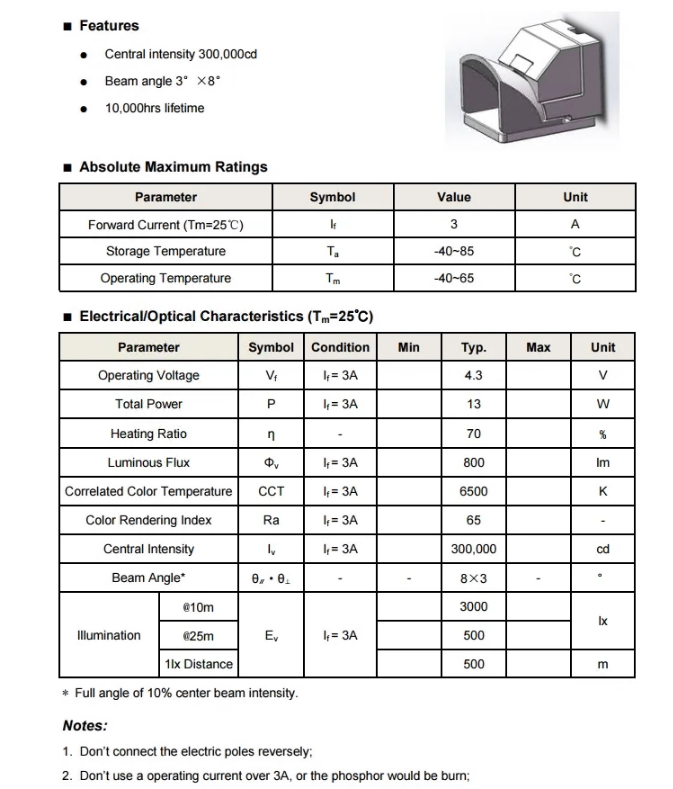
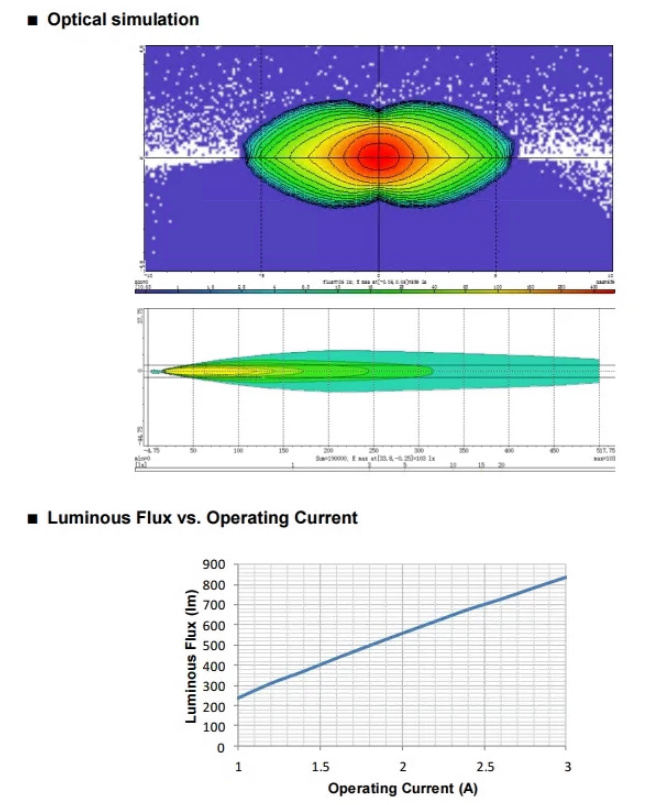
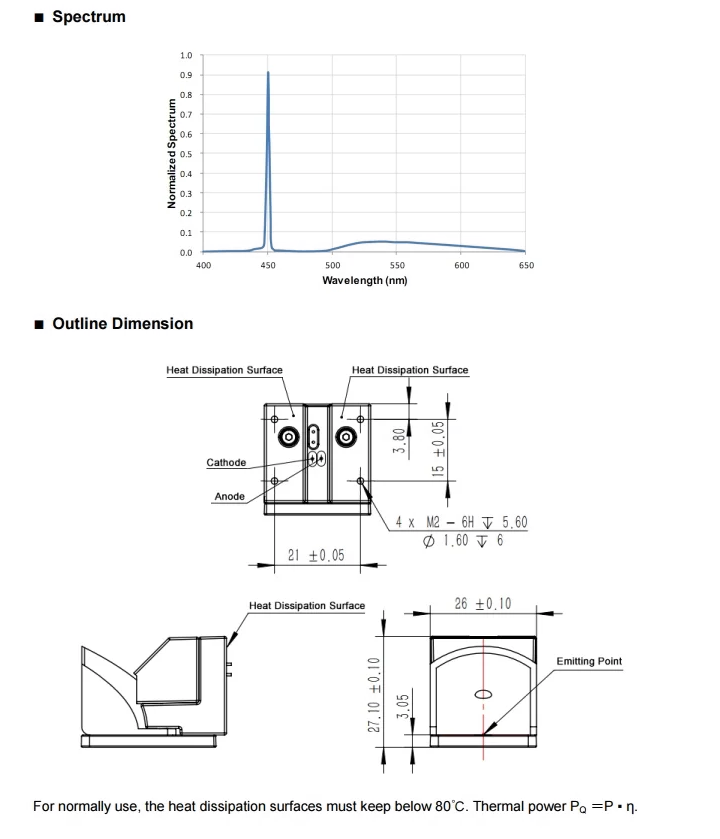
As to the Rayleigh scattering - I've found these premade TiO2 nanoparticles for sale, a bit pricy, but not terrible. They're in the <10-32nm range, depending on the batch no particle type. Alternatively, colloidal platinum in water solution can be bought off ebay. At 10ppm in of the photos, it seems to display some scattering: https://www.ebay.com/itm/276267554411. Note: Colloidal Pt might not work that well due to the particle size under 1nm (RS intensity depends on the 6th power of the particle radius).
Another option I've found is using the Stober process to create a SiO2 nanoparticle film directly on a glass surface. Requires thetraethyl orthosilicate, but it's not that hard to find. The author says:
In the 3rd hour, I got the dried film of SiO2 nanoparticle with beautiful opal color.
This post was modified 8 months ago 4 times by f0ff
Posted : 15/02/2026 12:08 pm

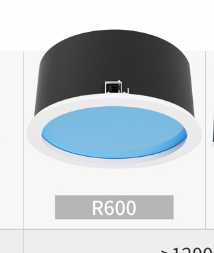
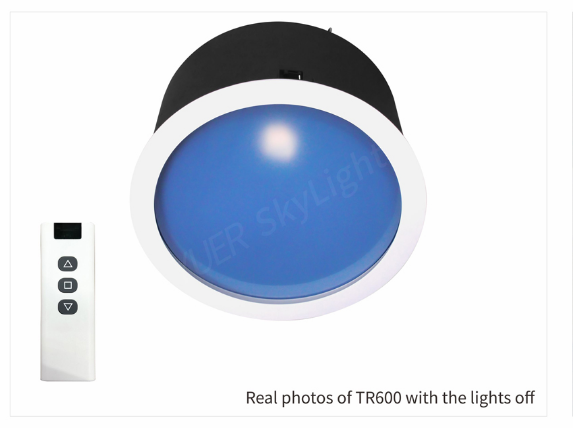
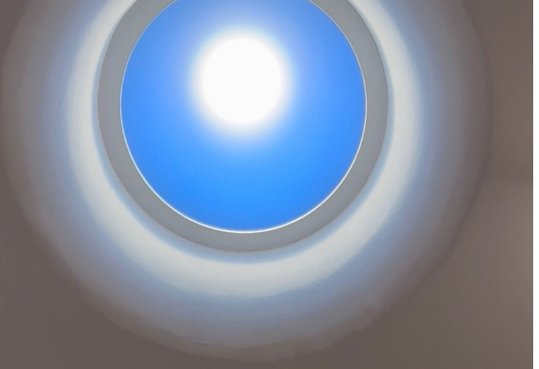
I've tried a few prototypes and I have yet to figure out how the chinese manufacturers at Yeursky and Auria Skylights create their "infinite sun" effect without using mirrors like Coelux does. I know Coelux uses mirrors, and their setups are quite extensive and large.
I've recreated a Coelux box with 2 mirrors and have had success creating a small parallel ray through a scattering sheet (inkjet) to create what looks like real sun, but to make it bigger and to mount it somewhere would be impossible for me.
Does anybody have any clue how setups like this create their infinity sun, or is it just an LED taped to the back of their boxes and they sell it as an infinity sun when it's actually not? Super curious, as nobody I know here has bought the sun versions of these products to dismantle them to take a look.
True infinity sun or just marketing??
Posted : 20/02/2026 1:09 am
@f0ff CRI is pretty important as is increases the spectrum of light within, which means any method that scatters the light or filters it will give you a different effect. CRI 100 is the closest to real sunlight. That said, you would just have to test and see. You can probably be fine with a low CRI if the light itself is whiter, or if you're using a box to test this in for mounting, to play with colors like white or off-blues as the inside to scatter and bounce those colors back. Cardboard prototypes are pretty fun and I've made plenty and made some very interesting discoveries that way. Mostly failures, but lessons learned!
Posted : 20/02/2026 1:18 am
Wanted to post an update on a prototype I'm working on.
It's using the "Oblique" or angled lighting shell to cast light on a nearby wall, upside is looking at it from the back gives a great infinite clear sky effect. Downside is the moment you stand under it, the LED light is visible.
My next variations are:
2. Creating a lit box in all directions to create an infinite clear sky effect vertically like some commercial ones, but I did a test with an LED strip (not the one in the video) that went around the entire edge and it had the effect I was going for. The casing it sits in just needs to be a different shape than the current one.
3. I'm waiting for a spotlight to come in to try to create a stationary "sun" variety. It won't have the "infinity sun" that Coelux manages with mirrors, but it will at least have a 15 degree angle light to create sharp shadows, alongside 2500 lumen at 5000k. The CRI is 82 which isn't the greatest but for this test will be fine.
The downside Ive found with this Oblique version is that there is a small shadow in the lightbox I can't seem to get rid of, even if I angle the light inside differently, so that's been bothering me... but it won't be the version I end on I don't think so It's been a nice test at least.
I've tested 3 types of acrylic diffusion sheets (3mm): Frosted, one sided frosted, and tinted. The one in the video is an electric blue tinted frosted acrylic sheet, I'm waiting on an arctic blue which might give a nicer blue hue, or i'll paint the inside, we'll see.
I've played with the Inkjet diffusion sheet between the acrylic and it just muddies the result, but it will be most effective when I test the sun variation.
I've yet to find a company that will do a one sided frosted tinted acrylic, so I may need to put a reflective/plastic sheet between the acrylic and the frame to create the "window" look with the reflections.
This post was modified 8 months ago 3 times by Hexaclover
Posted : 27/02/2026 6:28 pm
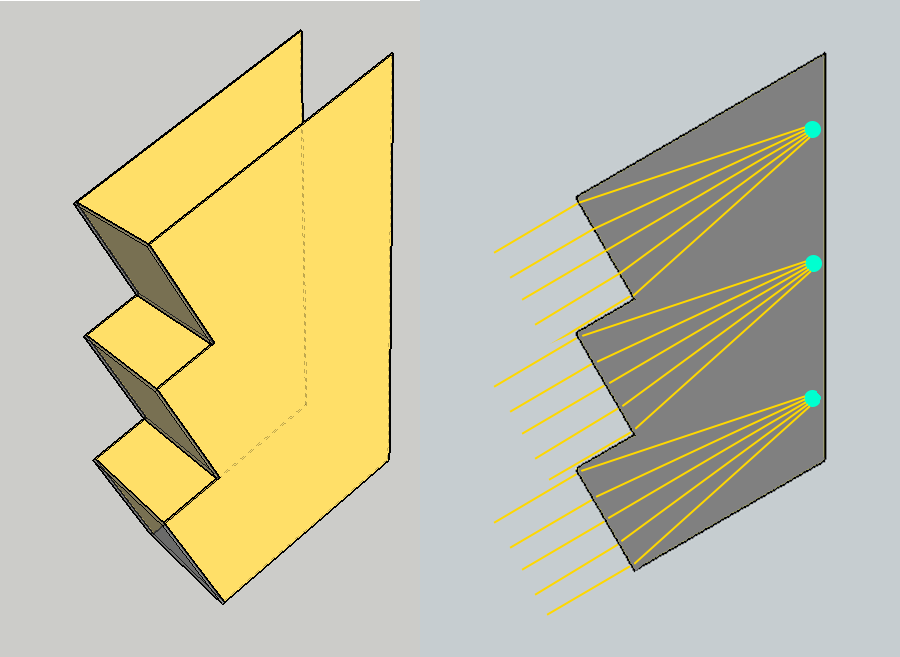
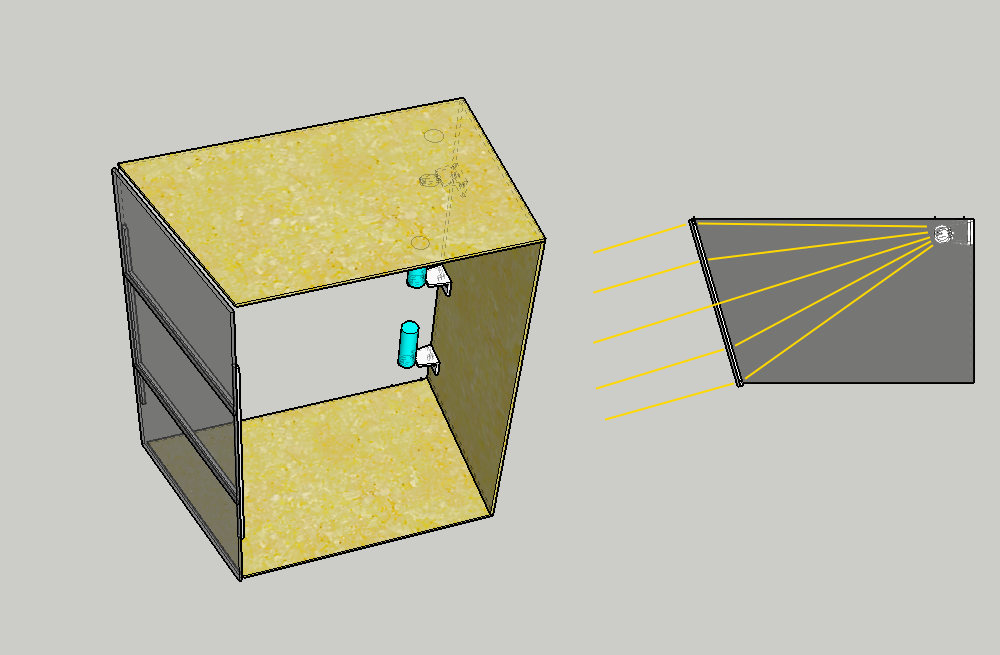
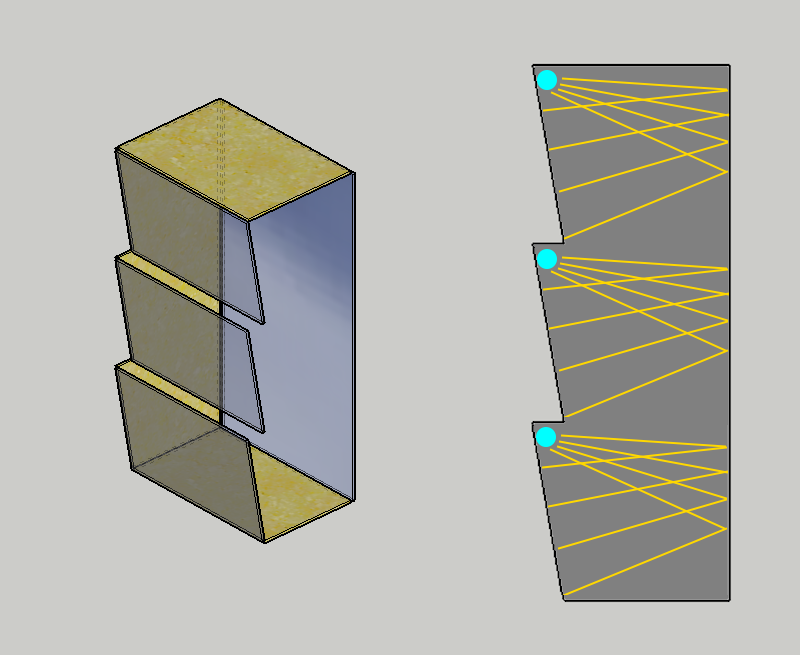
Of course I've been busy for the last six weeks of rain and darkness, now I'm free to work on it again it's spring and the sun is out... Anyway, my multipack of Fresnel lenses and 3W star LEDs turned up and I've been playing with designs for multi-lens boxes which will cast oblique light.
The first design was a "louvred" shape that would mount well on a wall, but it wastes some space and will be a lot of effort to build.
The second idea was to mount the bulbs in a corner of the box, which results in something easier to build but it's still prohibitively deep with a focal length of 24cm. Then when thinking about the commercial products with their mirrors and folded light paths, it occurred to me I could have a mirror on the back of the lightbox and mount the bulbs at the front right behind the lenses, making the whole thing a lot shallower. That will have to wait while I order some more MDF and mirrored acrylic (and test how close I can mount bulbs to the lenses without melting them!) but before that I'll put together a prototype of the second design and see how it performs.
Posted : 27/02/2026 6:50 pm

@hexaclover those are probably just a short focal length fresnel lens at one end with the LED at the focal point, which makes the LED appear at infinity, and something like the inkjet film others have found to diffuse blue light and make it look like sky, and the interior painted black. @remitchou posted a good example here of an array. I did a rough one with 300mm FL fresnel lenses. @jordiemc also did an array. There might be a couple more. They definitely look like a sun in the sky. It's actually pretty convincing.
There's another @diyperks video that illustrates the focus at infinity idea - found it, it's the projector, here.
Posted : 28/02/2026 3:55 am
@pyrrhos Would remaking something like this work with a single large fresnel lens at the appropriate distance from the LED inside a box, or are the multiple array fresnel lenses imperative to the illusion?
So the stack up would essentially be LED>Fresnel>Diffusion Sheet? Hoping to test something like this out soon.... but without a fresnel lens in my hands, I can't quite theorize on how to go about it lol.
Posted : 28/02/2026 12:09 pm
@pyrrhos Would remaking something like this work with a single large fresnel lens at the appropriate distance from the LED inside a box, or are the multiple array fresnel lenses imperative to the illusion?
So the stack up would essentially be LED>Fresnel>Diffusion Sheet? Hoping to test something like this out soon.... but without a fresnel lens in my hands, I can't quite theorize on how to go about it lol.
The ideal optically is a single, bright light source behind a single big lens, but because the focal length of a fresnel lens is usually at least as much as its width, lots of small light sources behind an array of small lenses lets you make the whole arrangement less deep. I'm working on one with an array of 8x5" lenses with a 10" focal length, which means the whole panel is less than a foot deep - using a window-sized lens would mean the whole arrangement is several feet deep. See the diagrams in my previous post (assuming it's got through moderation by now)
Posted : 28/02/2026 12:22 pm
@pkm_uk Ahh, I'm getting it now. I bought a very large fresnel to test but in the meantime I may also get my hands on a few small lenses and test that out instead if space is indeed an issue. I'm working with a pre-collimated light (a spotlight that's projecting light at 15 degrees using a built-in-fresnel) so I'll test out what whacky and weird ways the light will travel against objects. I also have a small parabolic mirror... "small" is still pretty large for inserting into a ceiling so... that'll be fun to test. Thanks so much for the information, the cogs are turning now!
This post was modified 8 months ago by Hexaclover
Posted : 28/02/2026 12:42 pm
@hexaclover I tried 300mmx300mm fresnel lenses with a 300mm focal length. They're almost too big. The problems I ran into are:
1) you need very bright LEDs, because the light for a large panel is spread over a larger area. I used 18W COB LEDs, which were pretty bright. That, in turn, requires heat sinks and probably active cooling, and an additional power source (I just used 12V CPU fans). Then you need the extra head space past 300mm for the heat sinks and fans. I assume for an array of smaller ones you could use lower wattage LEDs and passive cooling with a heat sink only, which really simplifies the design.
Note: I tried to do the math on this, curious if anyone else has figured it out. Sunlight at noon with the sun overhead is about 100,000 lumens per square meter I think. A 300mmx300mm panel is .09m^2, so it should get 9,000 lumens if you want perfect daylight levels. I think LEDs are around 100 lumens per watt, so that would be a about a 90W LED if you could capture all of the light from it, which obviously you can't because it's only getting what hits a 300mm panel at 300mm distance. Anyway, I figured it's unrealistic for me to get anywhere close to real sunlight, but if you want the illusion it really does have to be as bright as you can design it safely.
2) the fresnels are very thin usually PMMA, and at that size actually I think tend to sag or flex in the middle if only supported on the edges. Not much, but the tolerances to get collimated light at a good distance are very small. So they need a very rigid support farther in from the edge, or tension, or an extra piece of stiffer cleaer acrylic or plexiglass underneath to support it.
On the plus side, I think big panels are a little easier to collimate close enough than small lenses and LEDs, which would have very tight sub-mm alignment to get good collimation at a distance of meters. One of the guys did a CNC-routed aluminum frame for his array, but I don't have access to that kind of thing. Another benefit is that I think they might look better. The sun is only .5 degrees apparent angular size in the sky - not a point light source, obvi, but the larger the LED you use, the more diffuse the shadows and the less it looks like sunlight. One very bright and small LED per large panel can look very close to natural sunlight.
Posted : 01/03/2026 4:26 am
I also have a small parabolic mirror... "small" is still pretty large for inserting into a ceiling so... that'll be fun to test.
@hexaclover now I'm seeing possibilities for sunlight simulation everywhere - my local Italian restaurant has spotlights that look like a single LED in a parabolic reflector with a honeycomb baffle in front to further collimate and cut down stray light. Their baffles are black but of course, if it was light blue... Now I'm wondering how to obtain or make a lot of mirrored palm sized parabolic reflectors. In industry it would be vapor deposited aluminium but I can't do that in my kitchen!
Posted : 01/03/2026 7:51 am
@pyrrhos Gotcha, lots of interesting things to consider here. I haven't found a commercial light that gets anywhere close to 9000 lumens, other than a 100W COB Led with a heatsink and a TIR lens bracket with a 5-15 degree TIR lens inside of it. I think that's the closest to sunlight beam levels of light I could possibly make. My next move will be setting something like that up but with limited knowledge of wiring and voltage, I'm going to cautious.
My biggest worry is honestly how much electricity I might be able to accidentally pull if I make my own LED kit with the COB because I live in the UK, and it would be a hefty bill hahaha, burning my house down is secondary at this point. Research to be had.
I'll test the point light getting here in about a week's time and I'll post more of my findings, the large fresnel lens should also be here in about that timeframe, so I'll have a lot of things to test. Exciting.
Posted : 03/03/2026 5:34 pm
@pkm_uk I see possibilities everyday! I'm always studying how my spotlights light up a room and what color temperature they are, how real sunlight hits the walls in the morning and how I can replicate it accurately in my future builds. It's exciting. It does suck when you have an idea and it doesn't quite pan out how you planned, but you learn something from every experiment and I find that really fun too!
Posted : 03/03/2026 5:41 pm

@shavings Hey, I'd love to pay for a piece of that roll, if the offer still stands 🙂 I'm in Europe (France), gonna try to recreate something close to your design for a playspace in an attic
Posted : 10/03/2026 12:45 am
More progress, more updates! I'm closer than ever before to creating my own version of the Yuersky skylights/thinner Coelux skylights.
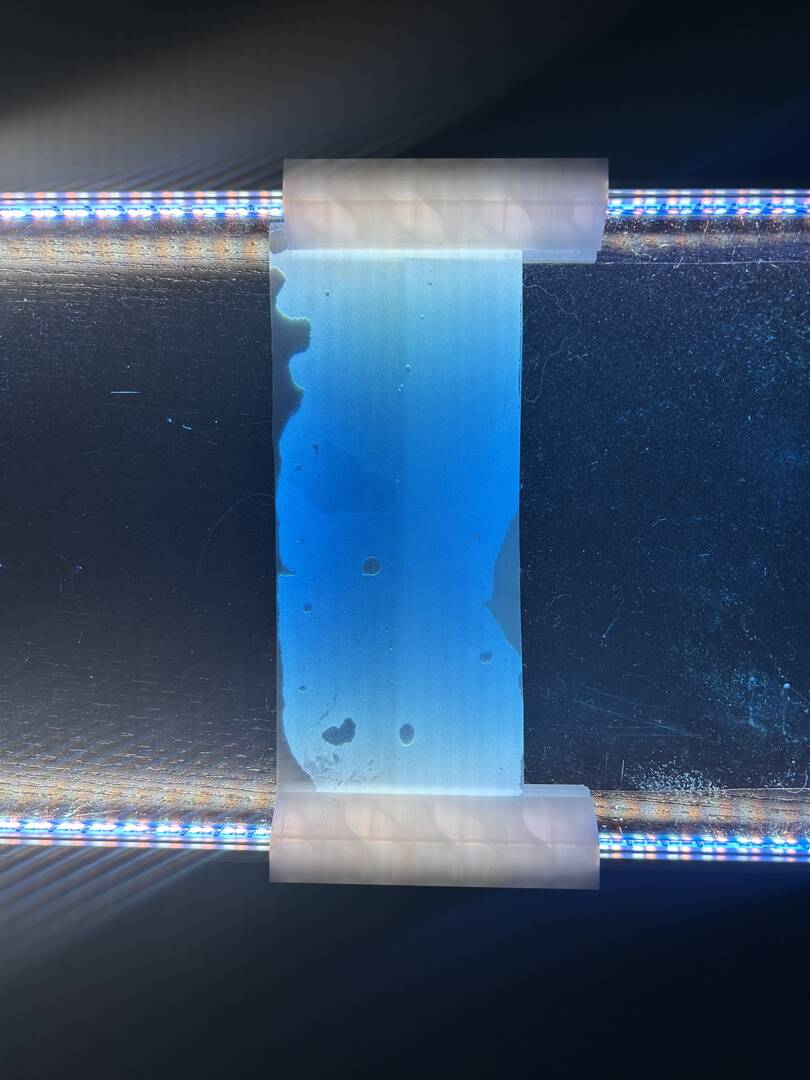
In my last post, one of the problems I described was the inkjet film + clear plexiglass combo looking too grey. I'm happy to report I've solved that problem. Fluorescent plexiglass was the trick. I found a fluorescent blue color from Canal Plastics, and when I combine that diffusion film I found from Amazon, it looks much closer to sky color. In my rig below I have the LEDs held in place by 3d printed edges. On the left side of the blue strip there's just black desk below, and on the other there's reflective film. Reflective definitely looks better.
I tried a few different materials for this diffusion layer and the film is probably the easiest so far. I originally thought about using the 3d printer filament as a diffusion film (this one specifically is a milky white transparent PETG filament), but the layer lines are way too distracting-- even when ironed. The one that looked the best was another diffuser I had for LED strips. That one is the top diffuser in this pic below. The ones below that are prints with various heights and ironing settings.
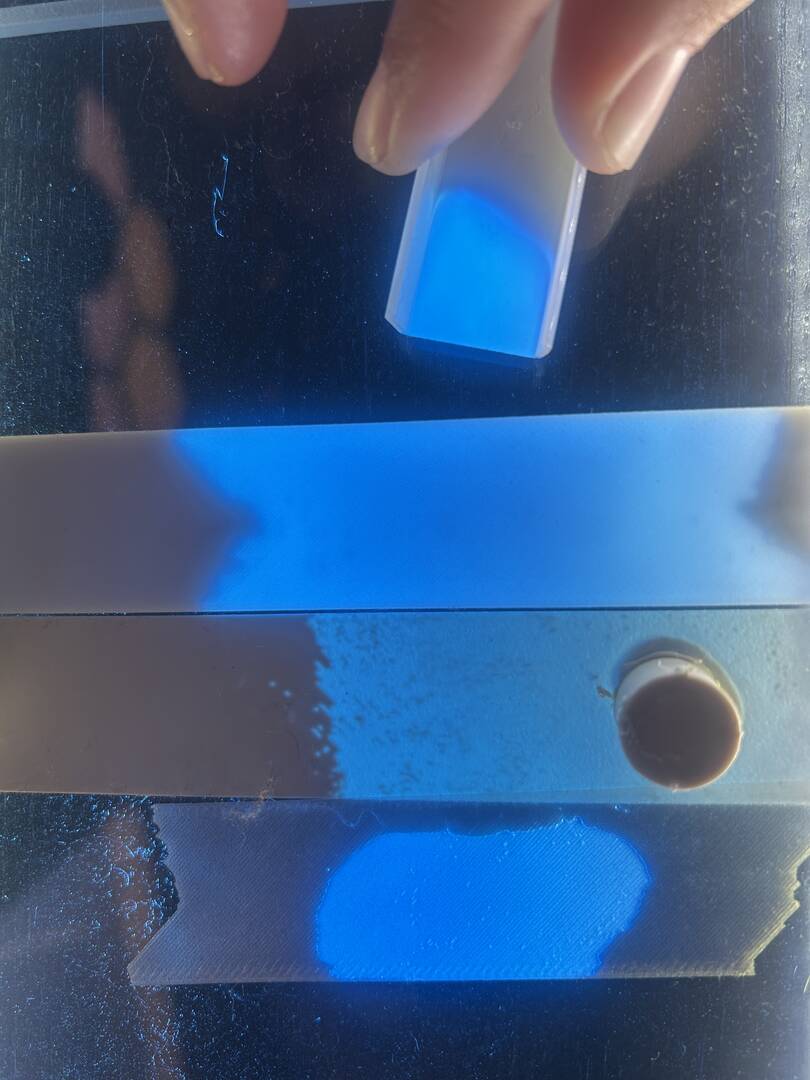
The biggest problem I have yet to solve is how to connect these diffusers to the glass. I've been using basic olive/grapeseed oil because it's got a good viscosity and is clear enough, but it runs and leaves unpleasant residues and smells. ChatGPT has suggested optically clear adhesive films, and I have found double sided ones that would be big enough for my use cases, but they're pretty pricey. And it seems like glass glue does not come in sizes big enough to effectively cover multiple square feet of plexiglass. Though maybe I could dilute it in some water to make it more spreadable. I also want to find a diffuser that has very little texture (the one from Amazon still has a bit of noticable texture when connected to plexiglass) and find a way to spread the light from the LEDs a little better (you can see in image 1 the sky's more white towards the edges), but I can live with those in a finished prototype. Any ideas on connecting diffuser to glass?
Once I have that fixed I'm going to 3d print a frame for the light and finally get that baby up on my wall!
Posted : 10/03/2026 6:57 pm
More progress, more updates! I'm closer than ever before to creating my own version of the Yuersky skylights/thinner Coelux skylights.
In my last post, one of the problems I described was the inkjet film + clear plexiglass combo looking too grey. I'm happy to report I've solved that problem. Fluorescent plexiglass was the trick. I found a fluorescent blue color from Canal Plastics, and when I combine that diffusion film I found from Amazon, it looks much closer to sky color. In my rig below I have the LEDs held in place by 3d printed edges. On the left side of the blue strip there's just black desk below, and on the other there's reflective film. Reflective definitely looks better.
I tried a few different materials for this diffusion layer and the film is probably the easiest so far. I originally thought about using the 3d printer filament as a diffusion film (this one specifically is a milky white transparent PETG filament), but the layer lines are way too distracting-- even when ironed. The one that looked the best was another diffuser I had for LED strips. That one is the top diffuser in this pic below. The ones below that are prints with various heights and ironing settings.
The biggest problem I have yet to solve is how to connect these diffusers to the glass. I've been using basic olive/grapeseed oil because it's got a good viscosity and is clear enough, but it runs and leaves unpleasant residues and smells. ChatGPT has suggested optically clear adhesive films, and I have found double sided ones that would be big enough for my use cases, but they're pretty pricey. And it seems like glass glue does not come in sizes big enough to effectively cover multiple square feet of plexiglass. Though maybe I could dilute it in some water to make it more spreadable. I also want to find a diffuser that has very little texture (the one from Amazon still has a bit of noticable texture when connected to plexiglass) and find a way to spread the light from the LEDs a little better (you can see in image 1 the sky's more white towards the edges), but I can live with those in a finished prototype. Any ideas on connecting diffuser to glass?
Once I have that fixed I'm going to 3d print a frame for the light and finally get that baby up on my wall!
Posted : 10/03/2026 7:03 pm
Our Customer used our CRI Ra 97+ daylight white 5600K led strip light to DIY a LED panel light to replace the his original bulbs in a softbox, it's very useful and good for photography and video recording at his studio, here is his feedback and project pictures,
Translate france to english,
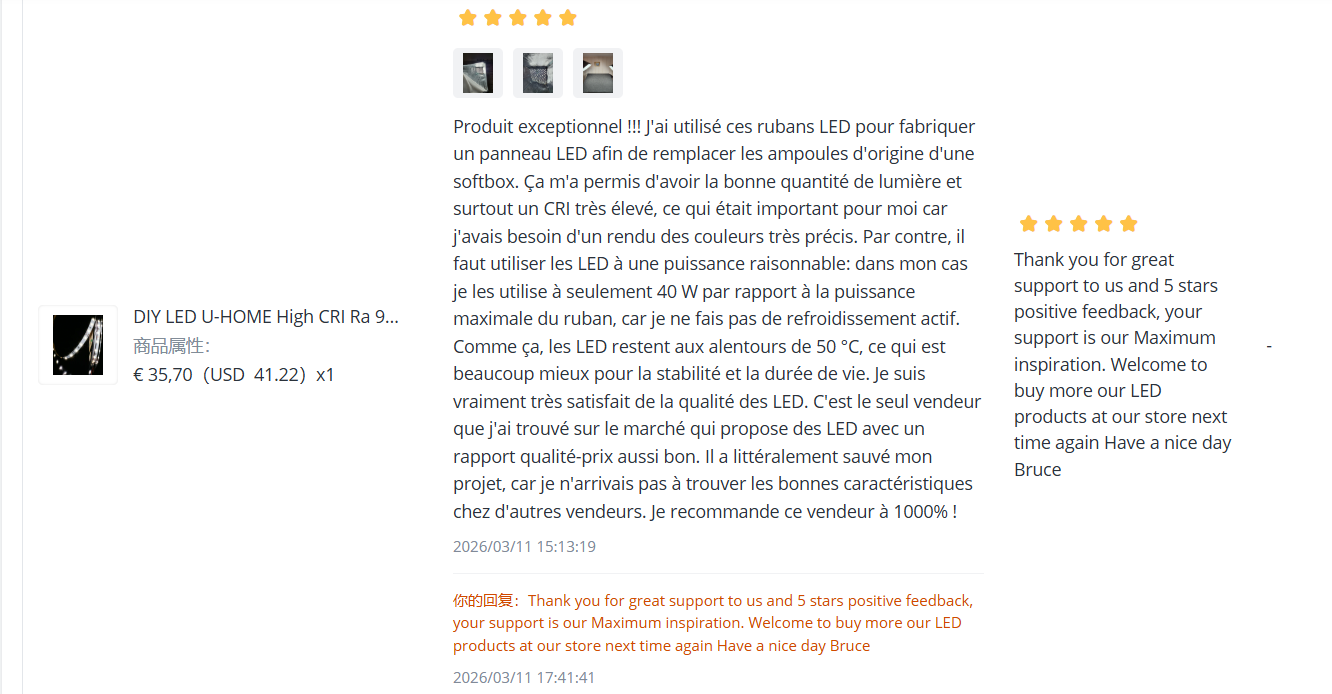
"Exceptional product!!! I used these LED strips to create an LED panel to replace the original bulbs in a softbox. This allowed me to achieve the right amount of light, especially with a very high CRI, which was crucial for me as I needed extremely accurate color rendering. However, it's important to use the LEDs at a reasonable power level: in my case, I only use them at 40 W compared to the strip's maximum power, since I don't have active cooling. As a result, the LEDs stay around 50°C, which is much better for stability and longevity. I'm truly very satisfied with the quality of the LEDs. This is the only seller I've found on the market offering LEDs with such an excellent price-to-performance ratio. It literally saved my project, as I couldn't find the right specifications from other sellers. I recommend this seller 1000%!"
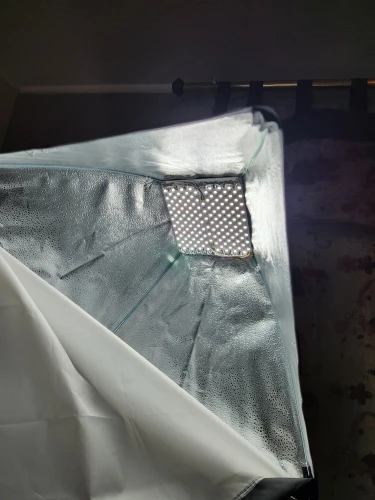
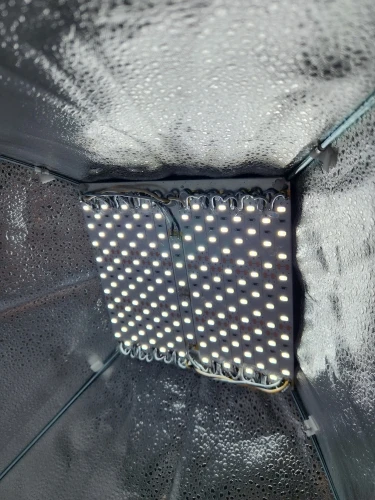
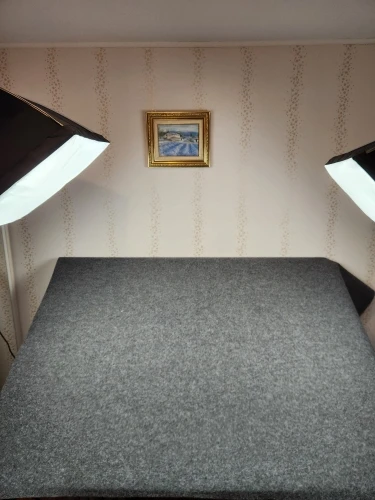
here is the link of CRI Ra 97+ daylight white 5600K led strip light at our store,
Aliexpress store, https://www.aliexpress.com/item/33005666342.html
DIY LED U-Home official brand store, https://s.c1ns.cn/dOT3a
Official Brand Store, diyledu-home.com
Our Tik tok account, @diyleduhome
Our Tik tok store, https://www.tiktok.com/@diyleduhome
Aliexpress store, https://diyledu-home520.aliexpress.com/store/1101410436
Ebay store, https://www.ebay.com/usr/joy-street, or https://www.ebay.com/str/indeedstore01
Posted : 12/03/2026 6:47 am

Thanks again to everyone in the forum for all the work toward both the optical side of the project and the long‑standing dream of creating a true Rayleigh‑like blue scattering panel at home. Looking back at @nolo’s epoxy experiment, it now seems likely that even with sonication, the hydrophobic TiO₂ particles didn’t remain fully separated and instead formed clusters large enough to fall into the Tyndall regime. That would explain why his cured epoxy sheet ended up showing a similar blue‑tinted look as the inkjet film: both materials scatter blue more strongly, but without the steep wavelength dependence that defines real Rayleigh scattering. For practical purposes, the inkjet film does give a visually pleasing sky‑like effect, but it doesn’t reproduce the true Rayleigh intensity shifts, and a genuinely Rayleigh‑accurate TiO₂ nanoparticle panel may still yet to be achieved at home...
I could be wrong and I may have missed that @nolo did some kind of characterization (DLS, SEM/TEM, or at least optical signatures) to confirm we were not just in the 100–500 nm Tyndall regime.
The relevance of this is that most gave up on the Rayleigh scattering at home realizing that it wouldn't be much better than the inkjet approach anyway... there is still hope I believe. I also wonder how much the light ends up being less collimated, or just more diffused, after passing through the inkjet film.
Posted : 14/03/2026 9:05 pm
marcdraco reacted