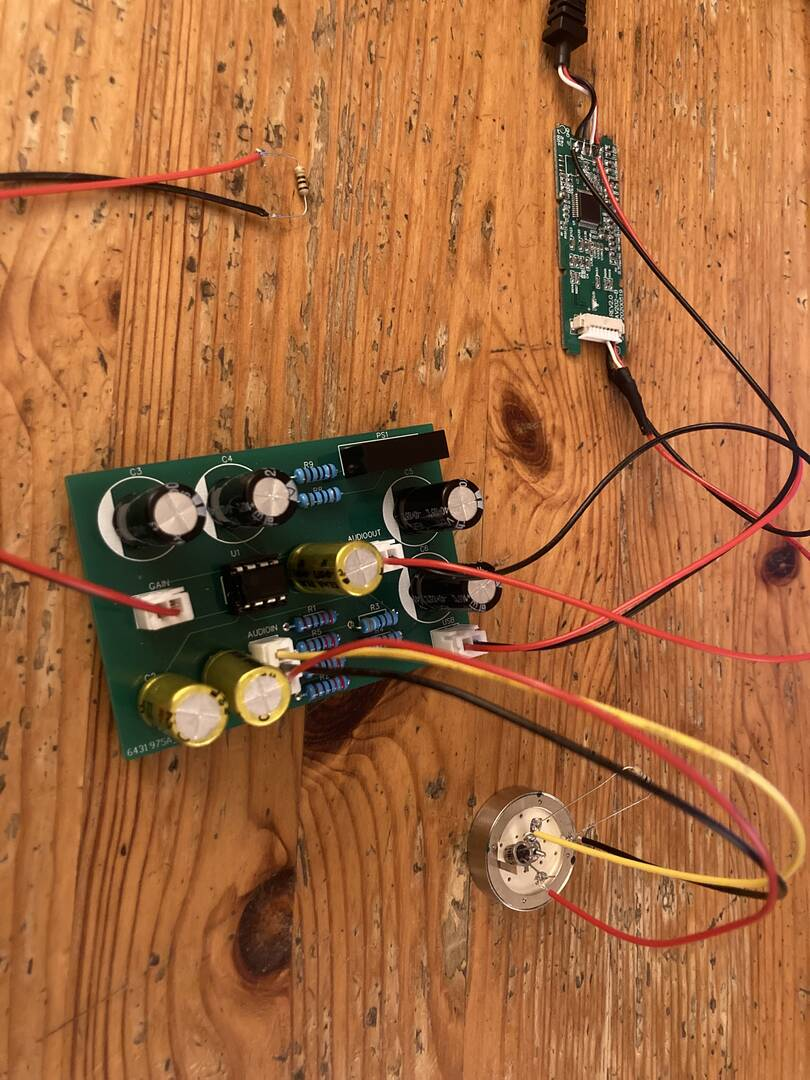
@v0lker6 Not sure if this is your problem but a few of us found that the THAT1512 we purchased on ebay or aliexpress were fakes. Might want to look into that.
Is anyone here from Australia? I can't find an alternative for the 2n4416 transistor. I just can't spend $24 on shipping for a $10 part. I've looked up all of the other suggestions but all of them seem to come from the us. Which means lots of $ for shipping. The transistor is the only part I don't have.
P.S could someone tell me what I have to look for in an alternative. What specs I need to know to find another option for a transistor please. I know nothing about this. Any help is greatly appreciated.
@graydon-t Yeah I suspected this might be the case since the values i get from the pins don't seem to match what i should get. I'm pretty new to this so I wanted confirmation before ordering a new one. I hope it's the only issue I have !
This really is a puzzle isn't it. I've had similar issue with my own design (based on Matt's original which obviously works). The 1M resistor shouldn't be needed by the look of things as the circuits seem to work fine without it (this one is on me).
The THAT does seem to warm up quite a bit which seems odd to me too - but I expect (I haven't checked this) that it might be very high-frequency noise which this circuit is vulnerable to driving the THAT into overload.
The capsule (with FET) will load the NMA0515 a little so don't worry about that voltage drop. Your supply voltages look good. The THAT works all the way down to +/- 5v (10 in total) so that's not an issue.
That changing voltage is due to the capacitors charging (slowly) so don't worry about that. You can't really measure a resistor in circuit because the other components surrounding it will affect the results you get. A multimeter injects a small amount of current to do the measurement and that will charge any capacitor nearby. A large cap/resistor will take longer to charge.
I'm currently finishing off (yet) another set of "head end" boards that mount directly to the capsule and now drive the ADC directly. As you can imagine they're not compatible with this board so that's no use to you. The last lot produced a very low noise output (rivalling Rode's NT1) but like you I've been unable to get the THAT to perform as expected, hence I'm working on something entirely new for everyone. This one has some special-order parts so they will be a few weeks before I can even get an order in.
If you have a breadboard you could hook up the THAT to a couple of 9V batteries (watch the polarity) and use one of THAT's simpler examples to make sure it actually works. As @graydon-t has mentioned there are a LOT of Chinese fakes around. Although some do copy the silicon (as in the case of the XR2206 function generator) it's easier to just get a batch of existing ICs, remove the maker's coding and put something else on.
Sounds mad? Consider the case of the THAT1512 vs a common single Op Amp like the TL071.
On this chip (which is dead common and cheap) pin 8 is not connected so you can connect that to pin 1 (Offset Null A) without changing anything electrically. That would leave the ground reference on the THAT connected to Offset Null B - or ground. Probably not a great idea if I'm honest but the counterfeiters don't care, they have your money.
The other pins are exactly the same even though the function is entirely different so it won't work. I expect there are more suitable amps (without even an offset null) that will appear to do "something" in these circuits, but they won't work as the gain is set entirely differently. I think this is probably "doable" with a THAT but there wouldn't be much point.
Take everything I say with a pinch of salt, I might be wrong and it's a very *expensive* way to learn!
@marcdraco thanks a lot for the detailed answer. I will only be able to work on it on weekends so I already ordered a THAT from mouser to quickly replace it if that was the issue. I'll try to test the chip I already have with batteries as you suggested so if it ends up working (but i'm not too hopeful, I bought it really cheap from ebay) i'll have to find something to use the second one.
I am just bumping my post (please also take a look at the very first one) as there is a new page available under this thread and I fear that my posts got lost.
Apparently, it takes a few days until my posts are approved (?).
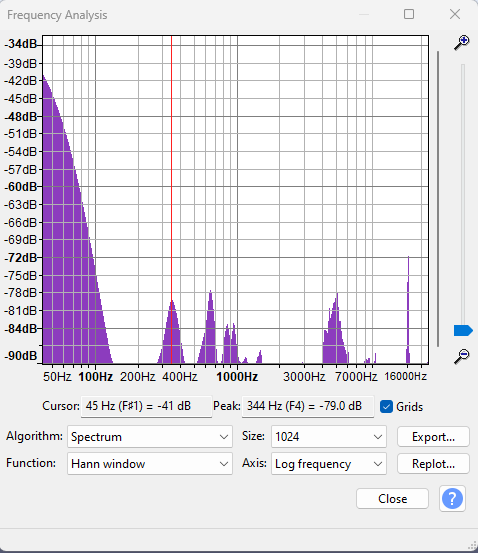
It seems like the frequency analysis that I posted in my previous post is more relevant than the very first clip that I shared in that post. It looks like the interference/ beeping here was an outlier rather than the norm. Quality sounds like this usually:
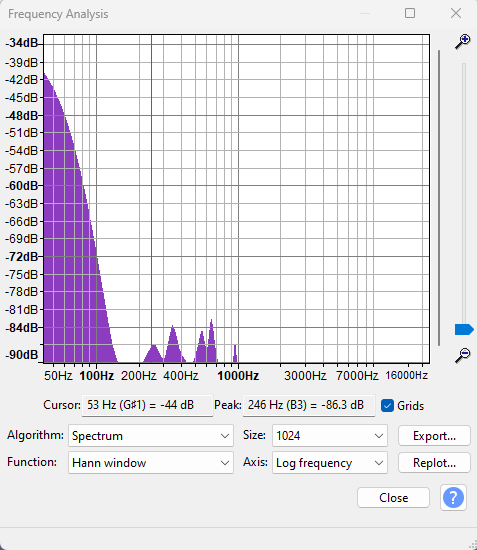
With this as frequency analysis:
At high volumes, some interference is still quite audible. Is this 'massive' peak around 50 Hz normal for this kind of microphone? What could be the source of this interference, especially as I see it only when the capsule is connected?
I have to admit that currently, I did not use an audio cable, nor the wire of a motor coil for connecting the capsule (I had done this previously, but I had to do so much troubleshooting that I just switched back to Dupont cables...)
However, the cables are shielded! I had some spare shielding tubing lying around from another project of mine, so I put all 3 wires trough the shielding.
I would expect therefor that this is not the root cause of the issues, as I would expect that this divergence from the original project only makes my mic/ cable more sensitive to tapping/ touching. Yesterday, I suspended the capsule into a shock mount that I 3D printed, so there is no need to hold/ support the capsule manually.
One more rather weird observation I made is that touching the wire cage around the capsule results in a lot of humming on the output; shouldn't me touching the GND/cage not result in any change of noise/ interference apart from the above mentioned possible tapping/ scratching sounds due to transmission via thicker cables?
as an update to my last post: here is the performance of my mic with the amp being powered by a Power-bank. I now realize that I still have a very audible beeping sound in the background when cranking the playback volume higher...:
How can I fix the beeping issue?
I can confirm that now, when I disconnect the capsule from the amplifier, there is no audible beeping anymore. Even when cranking the gain very high after the recording, I can only hear static noise.
Connecting the capsule now causes the audible beeping.
Also, I would still be interested in how to solve this ground loop issue in the correct way (can it still have to do something with that issue as well?).
EDIT (Again):
Sometimes, everything seems to be working quite well.
Here is a sample of me being simply quiet:
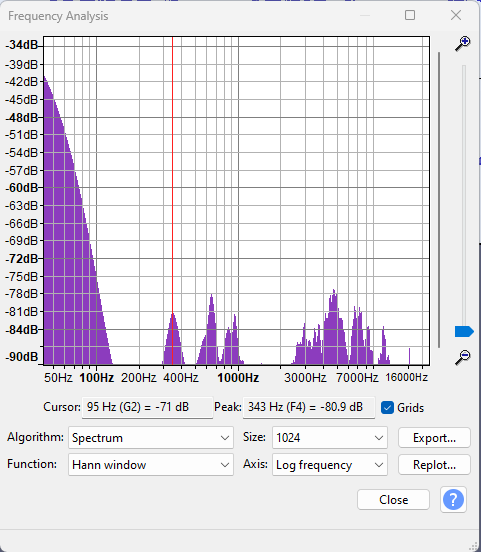
The spectrogram looks like this. Is this distribution to be expected?:
OK, instead of editing I will just create a new post.
I managed to get a bit further in my build, by physically extending the distance between e.g. power supply cables and data cables. The beeping now seems to be gone, but I have a slight buzz still audible:
Recording, played via phone again:
Spectrum:
Can this still be fixed/ resolved? Or is this somehow the limits of what can be achieved/ 'the room' that's being recorded?
I guess on normal volumes, it is not really audible, but if I crank the volume when playing back/ gain when playing back, it can def. be noticed.
Or is this something that has nothing to do with interference anymore and needs to be solved by using a higher resistance for the gain?
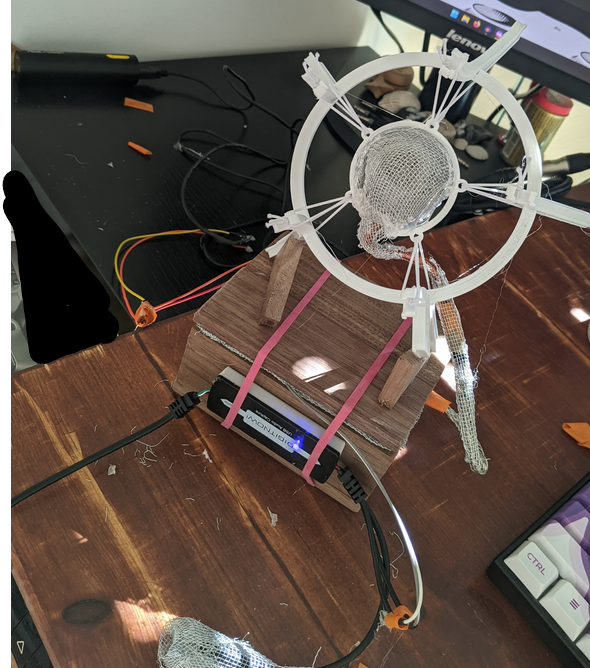
This is a pic of the current setup (very WIP at the moment):
The box made out of wood scraps is shielded from the inside. The audio interface is not inside of the box as this caused massive interference.
As a beginner, should I use one of the pcbs posted on this forum or stick to the original design? I'm worried that the design used in the video could be outdated or have some flaws. I haven't had the time to check through all the forum posts.
I received the THAT from mouser and I finally have some sound ! Well the issue is that i barely have anything I can only hear anything when blowing or tapping on the capsule. I can hear my voice really low if I shout but that's all.
I did not have any shielding at all when testing, will proper shielding make the sound louder by removing the noise or is there another issue ?
@swagmaster Matt's layout is (strictly) suboptimal but it works for most people. I'm still developing a improved head unit but due to life getting in the way, I'm a lot slower than I'd like to be.
The last crop of heads worked. Well, the ones I expected to work, worked, the ones I wasn't sure about were "me'h" at best. I've put a very high bar on my own designs and I'm not about to encourage people to lay out money until it's "idiot (i.e. me) proof" to the point that I would feel OK for someone with limited experience to construct and be reasonably guaranteed to get a great result.
Take everything I say with a pinch of salt, I might be wrong and it's a very *expensive* way to learn!
@swagmaster Matt's layout is (strictly) suboptimal but it works for most people. I'm still developing a improved head unit but due to life getting in the way, I'm a lot slower than I'd like to be.
The last crop of heads worked. Well, the ones I expected to work, worked, the ones I wasn't sure about were "me'h" at best. I've put a very high bar on my own designs and I'm not about to encourage people to lay out money until it's "idiot (i.e. me) proof" to the point that I would feel OK for someone with limited experience to construct and be reasonably guaranteed to get a great result.
Take everything I say with a pinch of salt, I might be wrong and it's a very *expensive* way to learn!
@swagmaster Matt's layout is (strictly) suboptimal but it works for most people. I'm still developing a improved head unit but due to life getting in the way, I'm a lot slower than I'd like to be.
The last crop of heads worked. Well, the ones I expected to work, worked, the ones I wasn't sure about were "me'h" at best. I've put a very high bar on my own designs and I'm not about to encourage people to lay out money until it's "idiot (i.e. me) proof" to the point that I would feel OK for someone with limited experience to construct and be reasonably guaranteed to get a great result.
Take everything I say with a pinch of salt, I might be wrong and it's a very *expensive* way to learn!
@robert yeah i'll do that, I just wanted to test if any sound was coming out before but even static noise was low so I didn't really know what was going wrong.
I read again previous posts here and I found the answer: don't add a 1M resistor between the gate and ground, it's not enough apparently. After removing the the resistor I had normal sound !
That 1M resistor "trick" is on me, I'm ashamed to say although it came via several well-qualified experts in the field. While a load resistor is needed to "change" the tiny output current into a tiny voltage which the FET amplifies, it looks like this is only needed when we're using an unbiased condenser - that's the type that uses 40-80 volts of plate charge to work.
Take everything I say with a pinch of salt, I might be wrong and it's a very *expensive* way to learn!
For anyone wondering where the new designs are - I promise they are coming, I'm developing some new features which are superior to the originals although we did manage to get pretty close to the Rode mic.
I'm limited now because I can't get the THAT1512 in SMD from my manufacturer so I'm working on an alternative.
Take everything I say with a pinch of salt, I might be wrong and it's a very *expensive* way to learn!
I really needs some help to get the last component for this project. If I were to use Mouser to purchase the 2N4416. It will cost me $40. I have spent over $100 already and that'sjust on the electronics, no coper structure. I need to find a local option for this part. To do that I need to know what to ask for. Can someone please help.
What do I need to look for in a replacement and what doesn't matter.
I really needs some help to get the last component for this project. If I were to use Mouser to purchase the 2N4416. It will cost me $40. I have spent over $100 already and that'sjust on the electronics, no coper structure. I need to find a local option for this part. To do that I need to know what to ask for. Can someone please help.
What do I need to look for in a replacement and what doesn't matter.
Any (almost) general purpose nJfet will do the job. Just be careful to get one with a pinch-off less than -1V.
most will work to a point but common ones like the 2N3819 are a little insensitive.
The part is discontinued but you can get lots of 2SK170 (also discontinued) and the LSK170 (replacement, better performance). This is the one I prefer for my improved design based on Matt’s original.
I’ll draw up some heads that will take any general FET so we can dodge this problem. JLCPCB can produce sheets of 9 heads by 5 sheets for about $15 shipped to your door. There’s one on my GITHub right now but it’s not ideal because it’s for two specific parts
I’ve had mine working with quite a few different FETs under experimental conditions. We’ll get you working as soon as possible
At a pinch, let me know the part numbers that you can get and we’ll see. Plastic encapsulated parts are just as good as we’re not in an RF stage.
Take everything I say with a pinch of salt, I might be wrong and it's a very *expensive* way to learn!
Here's a list from one of the best manufacturers in the audio business for this type of part. Perhaps the best FET manufacturer in the world - there's around 150 examples here.
from this image I got from the above post, I have a question. What wires do I have to connect to the board from the audio interface? what wires connect to the red wire and which wires connect to the black wires?
Here's a list from one of the best manufacturers in the audio business for this type of part. Perhaps the best FET manufacturer in the world - there's around 150 examples here.
Thank you for your help. None of my local electronic stores has FETs that would fit those needs. The lowest pinch-off was 30V. I bit the bullet and put the 2N4416 from mouser on a line of credit. I hope it is a good part.
The Vp of a small-signal n-channel jFET won't be anywhere near 30V @salmonies.
And it's a negative voltage so if they've told you they don't have one, they're lying.
Typically you'll see something from -0.3 to perhaps -7V max. The other ratings (there's a lot of 'em) are important of course but that one is what counts here. The range of pinch-off for a given type can vary significantly (most sheets will give you the range) but the jFET will be in full conduction by the time the Vgs (voltage at the gate) has reached 0V or goes more positive.
It's entirely up to you but your local store should have a jFET, if it carries them, that will do the trick. MOSFETs (and other technologies are not the same).
A low-cost device might be worth trying out before you try Matt's designed one as those leads are very easy to break if a wheel comes off somewhere.
Take everything I say with a pinch of salt, I might be wrong and it's a very *expensive* way to learn!
Yes it was a MOSFETs and I know what that does, luckily. I told them what the part was for. They only has the MOSFETs plus a VHF and a VHF/UHF. I was told they wouldn't do either. That was all they had under njFET.
It's done now, I got the 2n4416 from Mouser. When it arrives I'll get to constructing the electronics. I already have the other components.
The only store I know of is Jaycar. I got everything there except the power, amp, 2n4416 and the usb cable thing.
The USB cable thing. 🙂 Love it. Clever little adaptor isn't it.
MOSFETs are not the same animal as nJFETs - sounds like you need a better electronics store.
This isn't an uncommon mistake because they are both field effect transistors but that's where the similarity ends.
JFETs (typically) come in depletion mode whereas MOSFETS are almost all enhancement mode. MOS have a much higher input impedance but are far noisier than JFETs and not suitable for this application due to higher input capacitance, etc.
But keep us posted and we'll look after you.
Take everything I say with a pinch of salt, I might be wrong and it's a very *expensive* way to learn!
"Hello! I'm truly impressed by the dedication you've put into improving this project. Although I must admit I didn't understand half of what you mentioned in your posts due to my limited knowledge in the subject, I believe you've done an excellent job simplifying the design significantly to achieve a high-quality microphone.
I have several questions as I'm sure I've missed a lot of valuable information. I noticed that you've created numerous designs and even managed to get an electronics brand to sell some of the boards you designed. However, there are many versions and technical details behind each one, making it difficult for me to grasp which would be the most suitable choice for my needs.
Here are my questions:
What is the simplest design you have with the best performance? Can you provide links for more information?
I also noticed that you designed a circuit with a headphone amplifier, but I couldn't understand if you have completed it.
In the end, it wasn't clear whether these microphones need to run on batteries or if they can be powered via USB.
Have you built a circuit for the 22/24 capsules? What about the 34 capsules? I apologize if I missed this information.
In any case, I happen to have both the 22 and 34 capsules on hand, so it would be interesting to try building something.
What I can tell you is that, although it would be great to buy pre-assembled boards, importing them to my country (Mexico) is too expensive. Therefore, it's more likely that I'll have the boards manufactured and acquire the necessary components gradually.
To facilitate communication, I kindly ask you to try to keep your responses as simple as possible, using statements like:
"This one is more expensive to build, but it's the most efficient."
"This circuit is the simplest for the 22mm capsule."
"This circuit includes a headphone amplifier," etc.
When you start speaking technically, it becomes impossible for me to understand, and I assume the same goes for many others here. I hope this request doesn't come across as disrespectful to you, but I want to believe that the core purpose of this project is to enable anyone with a soldering iron, solder, and plenty of patience to be able to create this microphone.
I apologize if it seemed that I wasn't being friendly enough in my expression, but as English is not my native language, I sometimes struggle to convey politeness in this language."
I'm new here and I'm thinking about trying this amazing project.
I have pretty inconsistant knowledge in electronics, I made some Arduino projects and designed some basic PCB in the past, but those were more about applying schematics instructions that doing real design, but whenever I need to debug a circuit I'm lost because I lack of core electronic knowledge.
I just read all the 18 pages of this thread. First I want to thank you all for all those instructions, advices, reports etc, those are very instructive (even though I understood only a few things)
My understanding is that the hardest part (when reproducing the original design) is to find legit components for the THAT and NMA0515SC as some ebay/aliexpress vendors sell fake ones.
Are there some easy steps to check those particular components when I receive them? Or is this "just" about doing audio tests on the final circuit and guessing from experience?
It depends on how many steps you want (I forget how many Matt specified by his gain vs. resistor table is in the video. You can also get the values from THAT itself (silly name for a corporation but whatever...) from the 1510 or 1512 datasheet. Both parts work but the 1510 has a different gain equation.
Looks like they're using one pole, four position but you can put extra ones in for specific gains.
I did have this all drawn up but like the goober that I am ... I lost in the re-shuffle.
I'm still struggling to get my version running due to noise issues in the power supply and like Matt, I'm a perfectionist so I won't be releasing that until it's ready.
Take everything I say with a pinch of salt, I might be wrong and it's a very *expensive* way to learn!