
Notifications
Clear all

While I'm at it, Matt mentions in the video that the 4th leg of the transistor that is soldered to the back of the mic condenser is not needed and can be chopped off.
I think I saw a user mention it can be soldered to ground to improve audio quality? This is what I did, should I just chop it off and remove it or is it fine to just leave it as is?
Worth quoting this one as it comes up from time to time.
This is the fallacy of what we call "self-reporting" in the science world.
The fourth leg is, indeed, a screen and usually would be connected to ground (and by ground I mean EARTH GROUND, not the 0v reference, the two are often confused, but they are not the same.)
I remember many decades ago, an apparently serious review in a serious HiFi magazine of the day (early 1980s) told of how a special paint for the lightbulbs could make your HiFi sound better. I think the idea was to prevent glass resonance but you'd need pretty good hearing to hear that over your Pink Floyd. More recently we've had oxygen free and even directional copper interconnects and speaker wires.
These things are pure marketing. Oxygen-free copper might well have a slightly lower intrinsic resistance per meter (on reliable measuring equipment) but the amount of current going down there utterly obliterates any difference. And "directional"? Gimma a break! But the problem is most people don't know that. Those of us who remember such things, remember being taught that the energy in a wire is ... well, in the wire. It's not.
Have a think on that and if your brain explodes, pop back and I'll explain why.
Sorry accidentally forgot to include this earlier. The tin case around the device (vs. the little epoxy ones we usually think of) is a Faraday cage (more of this back up the thread) because the device is actually designed for radio frequencies. Now consider where the FET is...
Inside a Faraday cage. It's already protected from external signals and devices in the vicinity are protected from anything it might emit.
In some instances, connecting the cage to 0V reference can make matters worse but that's outside of the scope of this. The screen would be used on a PCB that's open to signals. Putting shields around anything is expensive in material terms alone. Many devices are required to accept signals that might disrupt them while not emitting any that can disrupt other devices. There's a reason for that too, I'm sure.
So yeah, Faraday shields are like an electronic shell for the magnetic field emitted by nearby devices. Worse, but not likely audible, Matt's original joins the USB and inverter references together which has the effect of sending huge amounts of noise up the assembly like and aerial.
The very fact that we can't even hear that coming back is testament to why the claim "it'll sound better" is patently false. In some higher-power applications the case lead is also soldered to ground to remove heat more efficiently.
Take everything I say with a pinch of salt, I might be wrong and it's a very *expensive* way to learn!
Posted : 08/04/2025 9:13 pm

Thank you for you in depth explanation and the background, seems like I will need to order a new part after all... What are the steps I could take to ensure my circuit is safe for the new amplifier? I also intend to purchase it from mouser electronics this time, are they a reliable source of genuine components?
I shall wait for you to measure the THAT's resistances and check mine. I would like to know what's the tolerance for these as it could tell me whether it was a fake or not. I must have gotten confused between that part and the amplifier when it comes to counterfeiting reported on this thread. I currently have no way of telling.
If it does turn out to be a fake or even dead by my own doing, and if mouser is a good place to procure the parts, I would buy both from them.
Posted : 08/04/2025 9:42 pm
Glad this could be clarified, I see what you mean by the example of directional wires and stuff.
Would you desolder and remove the leg if you were in my position?
Posted : 08/04/2025 9:44 pm
Sorry Dunkan, I missed this. If you've already soldered the shield, just leave it as is. There's no gain either way and in fact the extra pin might help to stabilize the FET.
Take everything I say with a pinch of salt, I might be wrong and it's a very *expensive* way to learn!
Posted : 11/04/2025 2:54 pm
Regarding the schematic, is it possible to use true-condenser capsules, rather than a large electret? I would be amazed if so - imagine the noise floor performance! Can we get it to the level of a Rode NT1A???
The Rode NT1a probably has custom silicon to do what it does. Powering the capsule (for the unbiased types) is quite difficult, but a high-quality electret like the JLI2555 is already very quiet indeed. Much of the background (self) noise is caused by Brownian motion of air molecules hitting the diaphragm. There's nothing we can do about that and it's common to all high-sensitivity devices.
It is on the cards (I've found some interesting non-electret capsules) but the performance of the current designs is pretty hard to beat. The main difference seems to be that we can get dual diaphragm capsules. The biasing voltage needs boosting from 15 to almost 50V which requires a voltage tripler.
Anything around 40-70V is enough to bring the capsules up to spec, so that's a development that's on the cards. It's just that development is expensive and there's only so much in the pot. 🙂
Anyone else following along will be pleased to know that I've got several, fully functional designs on GitHub - which Matt will be getting soon. I don't like to announce them before they are fully tested.
Michelle 4.0 is a complete re-design from the ground up and doesn't need a THAT1512 but is a circuit used on many professional mixers licenced from designer Douglas Self's patent. Since the patent has expired I've used in for the new amplifier. The power supply has had a lot of attention and is now quieter and puts less load on the PC.
Jaime "Starfire" is a capsule adaptor that supports the newer P12 power system (a 12v supply down from the original 48v) and is suitable for very long cable runs, perhaps 10s of metres (yards) long.
Jane "Starfire" combines a smaller version of the the Jaime capsule adaptor and the Michelle 4.0 board in a single assembly. The capsule can be snapped off at a pinch. I'm just in the process of doing an even quieter version as the extra circuitry required to drive long cables does inject a little bit of noise from the resistors.
Some other boards are under development, including a fully through-hole design that's much simpler to assemble at home - that one will use the THAT1512 due to the extra complexity in Self's design making the component count rather high.
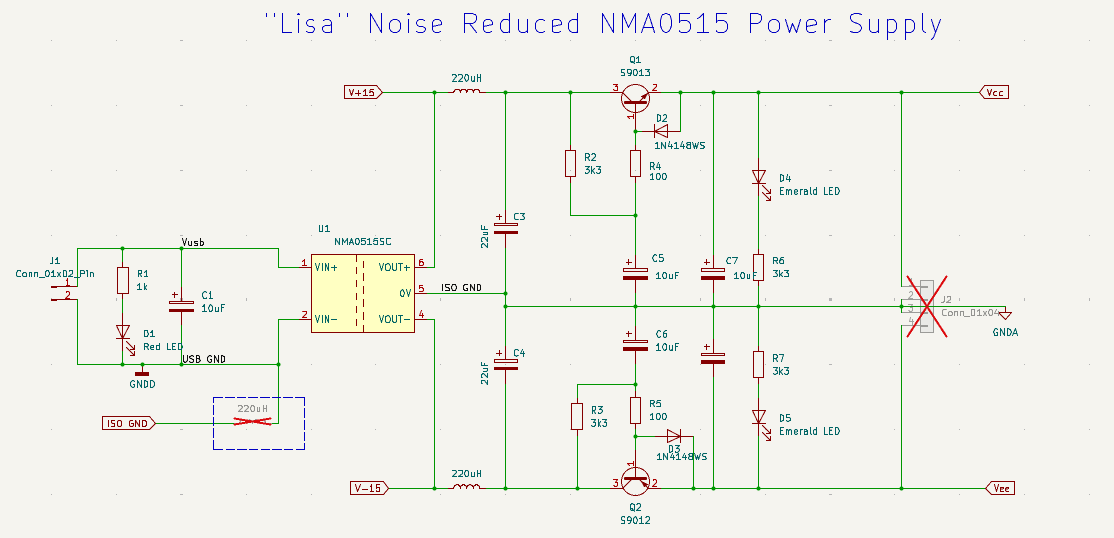
The schematics for these boards is included but you will need KiCAD (it's free) 9+ to read most of the files. If you work from the project you can make your own changes/improvements. For example, the S9013/S9012 can be replaced with "Darlington" versions so long as they have the same footprint. Darlington transistors improve noise rejection slightly while losing about another 0.8 volt from the supply - but that won't affect performance much.
This is the schematic for the revised power supply so you can see what I've done.
Take everything I say with a pinch of salt, I might be wrong and it's a very *expensive* way to learn!
Posted : 12/04/2025 9:14 pm
Latest designs - this one is a bit mad but it's specifically meant for Matt's original capsule design. It's smaller than the "Happy" multiple JFET carrier because you only get either a through-hole OR and SMD version. The SMD type has alternative footprints for SC-59 and SOT-23 JFETs which covers most of the decent designs. I recommend a 2SK209 (not the 208, which I've used previously) due to the higher gain.
Both designs need to "hover" a few "mms" above the capsule to avoid shorts but they are very compact and anyone with some intermediate soldering skills should be able to construct them.
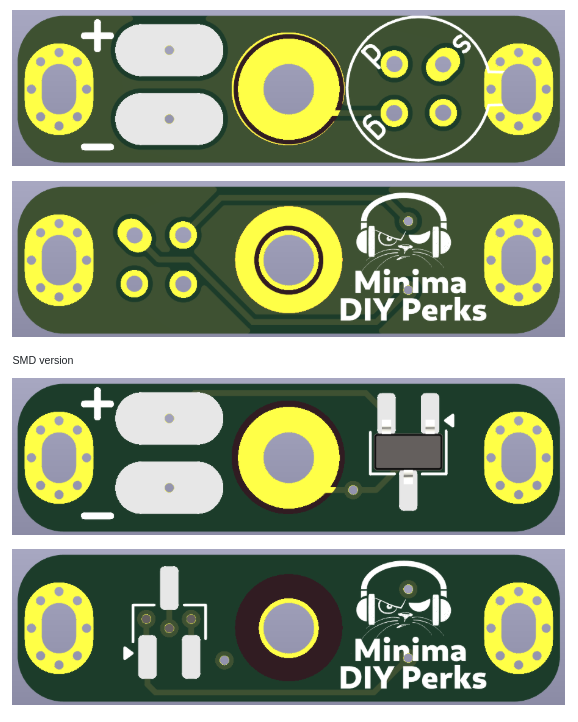
https://github.com/marcdraco/minima
The final designs for the V2 mic are done but I'm going to let Matt make the announcements as there's a lot of new stuff to talk about. Check out the GitHub by all means but some of the information is not there, it's for people who understand electronics. If you're like the rest of us, follow Matt's video! 🙂
Good things are ready, more exciting things to come.
Take everything I say with a pinch of salt, I might be wrong and it's a very *expensive* way to learn!
Posted : 13/04/2025 8:23 pm
PolarYetti reacted
I want to post this here in case it's an oversight on Matt's part but I realised something...
In the video he doesn't make mention of the fact he combined the USB Capture card's black GND wire with the shielding in the cable he uses to then hook up the breakout Type C board. I have elected to just use the Type A cable and the only information I could gather was from watching the video.
If you don't look at it very closely, you could miss the fact he combined the aforementioned cables into one. The thing you can clearly see is that the Red, Green and White leads go to their respective pads on the Type C board. When you look to the side, you see twisted up shielding cable going to the GND pad on the Type C board.
What I did when soldering the two wires drawing power from the USB Card to power the preamp circuit, was to solder the +5V lead to the red +5V lead of the USB sound card, but then I wired the black GND lead to the GND pad marked in the corner of the little PCB, off to the side. I did not in fact solder it to the black GND cable coming from the USB cable itself. I had to look up the pinout of a Type A cable to figure this out.
Correct me if I'm wrong @marcdraco but this is the difference you mentioned earlier between Earth ground and the 0V reference? If my deduction I drew from my limited knowledge is correct, would it have changed anything to my original circuit if I had wired the GND lead up correctly?
I was getting 4.96V to the NMA0515SC input pins 1 and 2 (+Vin and -Vin respectively as per datasheet) before taking it out to test in isolation. The other issue is that I was also seeing the exact same 4.96V at the output pins of the 0515SC.
I have also determined that my 0515SC is not broken as I previously thought, thanks to some guidance from Marc I tested it out of the circuit and found 31V at the output pins 4 and 6 (-Vout and +Vout respectively as per datasheet) which seems to indicate the 0515SC has not in fact died in my case.
As it stands I have not put the preamp circuit back together to test again but the values from the NMA when powered in isolation seem nominal from what Marc told me.
Posted : 15/04/2025 10:16 am
Meet the, er, family...
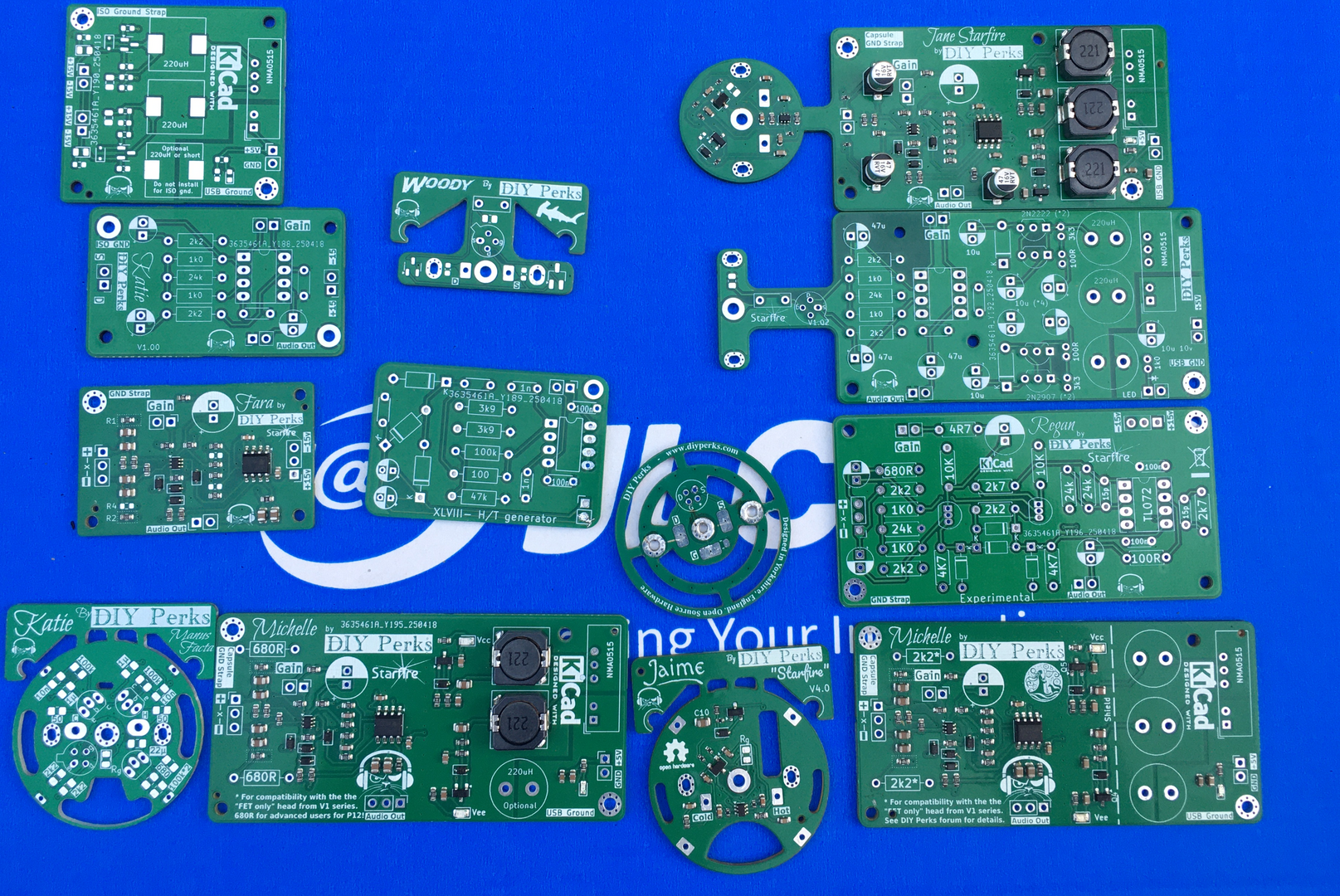
In case anyone is wondering what happened to V2? Meet the family (most of them anyway).
I've had the entire set manufactured, some are through hole (esp. Katie Magnus Factor) for people who can't afford the assembled versions - although you can also get the SMD ones as boards only.
This lot are off to Matthew (@DIYPerks) this week (sorry mate, I've been a bit backed up) so he can try them himself. Not shown is the fully assembled version of Liza which is a dual 15/-15V power supply for driving separate boards (it will likely need a 2W version of the NMA0515 for this however).
Some boards have integrated power supplies with extra filtering, some are based broadly on Matt's original (with a few minor mods), some will work with P12 microphones (Jaime, Varee although Varee is strictly for P48) and there are some P12 microphone capsule adaptors for those (Woody and Happy). Some, like Jane and Bobbi have integrated capsule adaptors - Jane's "head" can be snapped off and used separately.
Michelle is the premier model. It's designed for Matt's original head design (or the various FET only adaptors like Woody and some others not shown) but a simple mod (remove a couple of resistors and fit some through-the-hole types, it can be used with the long-range, low-noise P12 head adaptors like Jaime. By "long range", I'm referring to professional microphones that might have many metres of screened cable, although I expect most people will be better served by the simpler design.
There are also two versions of the preamplifier circuit - one based on the original with a THAT1512 and another based on Douglas Self's "Padless" design from the mid-1990 which is now out of patent. This comes in through-the-hole and SMD versions. The reason for this is the THAT is expensive and there are a lot of fakes floating around which cause more issues than they solve.
Nestled in her is the *experimental* high-voltage adaptor which is still in development. This is for Woody primarily right now and generates the low-current, 50(ish) volts for unpolarised capsules so people with money to burn can use really, really expensive condenser microphones - but it's not ready yet.
So if anyone thought I'd jacked in, I promise I never did, it was just like tempting fate to show everyone and then find the board had an error. Some of these did have minor mistake (mostly the silkscreens) which I've repaired at GitHub. I didn't want anyone to have to suffer from my mistakes.
Best to drop me a line on GH if you want to make anything up before Matt's video so I can check the correct artwork is there. I'm currently developing a little 5V-powered headphone amplifier as that's been requested by a few people. Per-board cost is under £5 plus tax and shipping from JLCPCB - but it's still undergoing testing right now to make sure I didn't goof something.
Why so many?
Different horses for different courses. I don't expect poor Matthew to show every board (and there's a top-secret one in development which is very exciting indeed. I hope that will make it in time for V2 but it IS coming, hopefully in time for the video. Assuming my kids don't drag me off to fix a lightbulb, washing machine, TV etc... Being a bit handy around electronics is a blessing and a curse. Cue the "Daaaaad, can you?"
I'll write up fuller explanations of how everything works but right now this project remains for people with some knowledge of electronics since I simply don't have the time to explain every function to everyone. If you have the know-how (even the basics) you can always adapt the designs to your own needs since they are all Open Source hardware.
You might, for example, decide that the Jane system is good (it's SMD) but you wanted the more responsive head design (Woody) and that's broadly incorporated into THT version (Bobbi) so you could just take both and adapt it from there - which is mostly a case of swapping the "head" part of the board that sticks out on a little neck. These are complete units that are intended for a desktop setup more along the lines of a Blue Yeti or similar.
Everything requires at least KiCAD 8 but since I moved to KiCAD 9, later revisions will require that. There are addons for major board houses like JLC and others so you can prepare your gerbers, BOM and position files - but be careful as bugs in KiCAD can result in some parts getting rotated - therefore it's essential to check everything before placing an order.
Typical one-off pricing is under £8 (UK) for assembled boards like Jane, Michelle etc. plsu tax and shipping. They are almost ready to work out of the box, you just need to add the volume control and a digitiser. All the heads are pre-fitted with a decent JFET but several (like Woody) will allow you to use pretty-much any n-channel JFET you are able to get if you prefer, SMD and THT included. The through-hole versions support the specified 2N4416 four pin JFET with the extra pin offering increased support but you don't need it (it's for screening in RF oscillators which is what the part is designed for).
Quality has been the main concern here. The improvements to the PSU (less pull on the USB and a more gentle startup) plus inductive filtering, ground isolation and capacitor multipliers make it easier to make the project with very low noise (zero noise isn't possible but that's not something for a "short" post) This affects all electronics, not just microphones. Distortion levels are excellent, marginally higher on the higher-voltage (FET only) design, per Matt's original but the extra sensitivity more than makes up for that.
On paper and in testing both designs perform very well but the THAT1512 is simpler for self-assembly. Further Douglas' design really needs fairly well-matched transistors for the differential input to get the best noise rejection. The SMD one uses a pair on a die so they are monolithic and naturally perform better.
And that's your update. I can't offer support for these until Matthew has done the video but I will be able to offer limited support to anyone with some know-how over at GitHub.
I'm also testing some new circuits with lower-cost electrets for stereo and even live surround sound recording (a four capsule setup). This probably won't make it to Matt's videos - at least for the foreseeable so I'll write that up (assuming it works).
To reiterate - these boards are broadly complete but I'd suggest (unless you're really desperate to get ahead of the game) you wait for the official video - Matt's far better at explaining this stuff visually that I'll ever be, so I can't offer much in the way of support if things go pear-shaped. Some boards are still experimental and while they do work, there might be some minor tweaks required.
Anyone with the means is encouraged to sell the boards on eBay/Amazon under the same Open Source Hardware licence. Retail price is entirely left to the seller, but you'll be responsible for supporting buyers if should things go wrong (unless you put a disclaimer on there). The "bare" through hole boards make for excellent kits if for anyone with the means to assemble the BOM and ship out with instructions. But test one first to make sure there's no comeback!
Credit and copyright for the original project remains with Matthew and the DIY Perks website, etc. (I'm just one of you guys!)
Take everything I say with a pinch of salt, I might be wrong and it's a very *expensive* way to learn!
Posted : 30/04/2025 8:41 pm
PolarYetti reacted

Hey, guys.
I've got a problem.
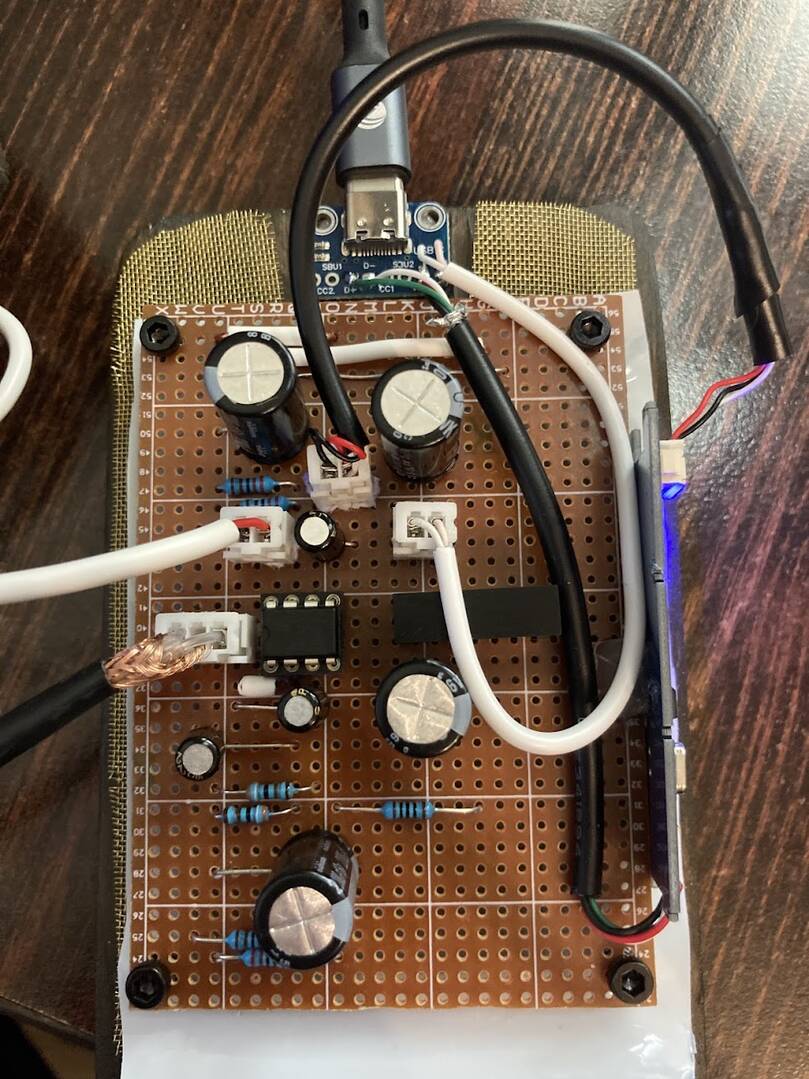
I have assembled the circuit, connected everything, but there is no sound at all, some barely noticeable noise, when changing the resistance potentiometer noise does not change in any way.
If you touch the capsule body with your hands, the noise disappears, but it doesn't react to anything else.
Chip 1512 warms up 55 degrees.
The problem may be in a defective chip or I may not have connected the Audio interface in the right way?
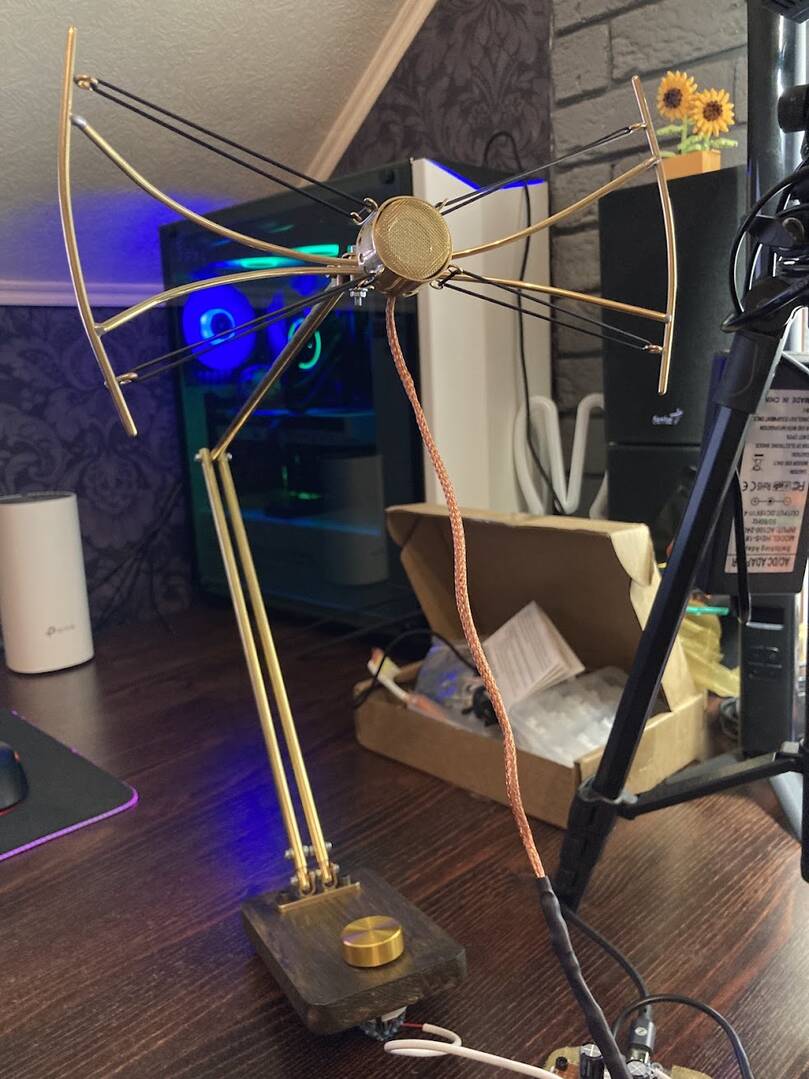
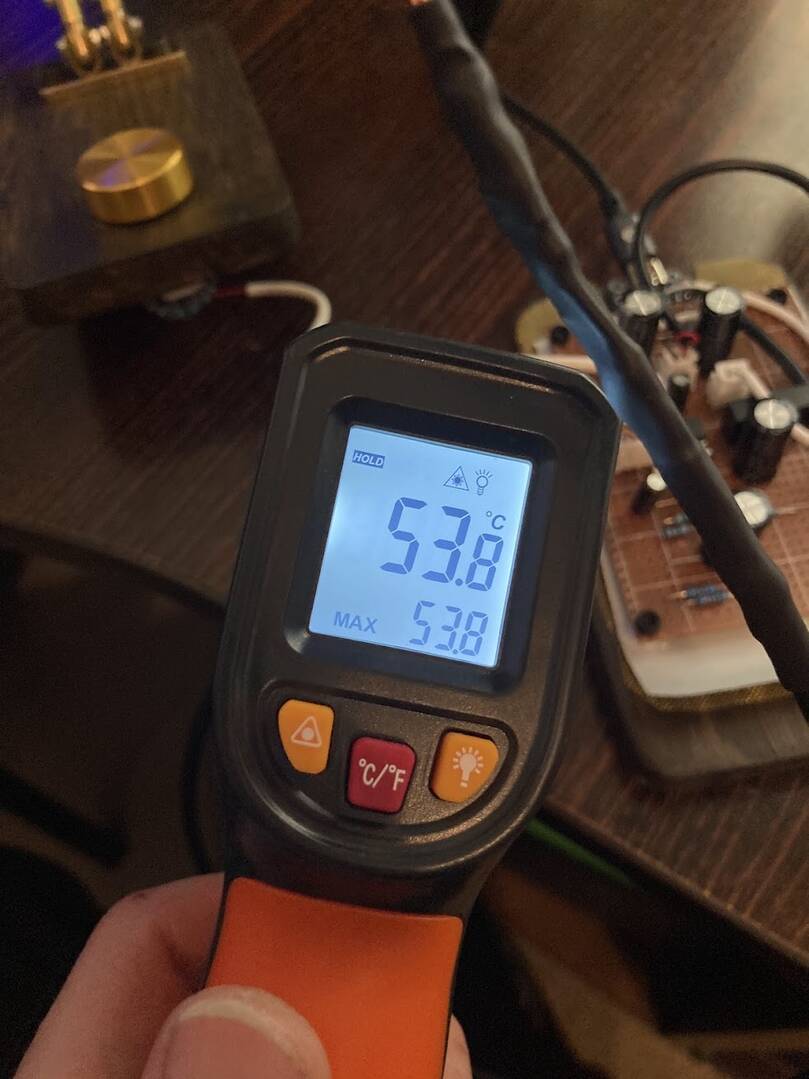
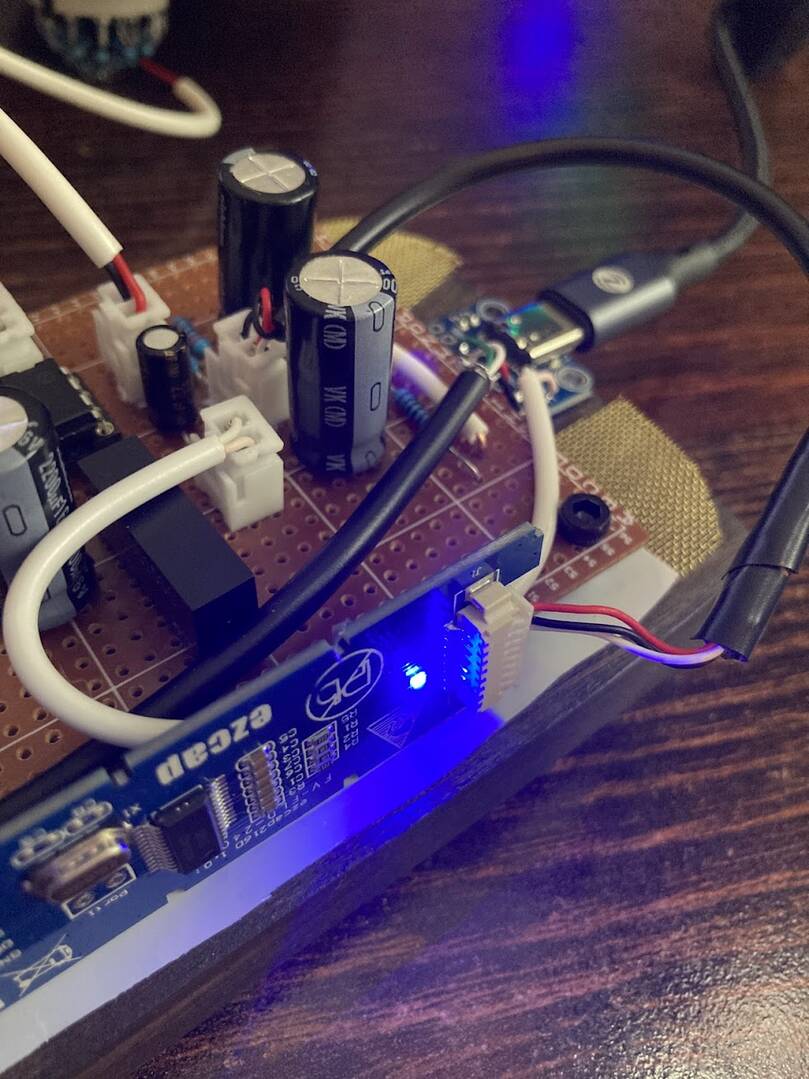
Posted : 02/05/2025 10:08 pm
Really nice construction work on the physical hardware.
What other tools to you have (I'll assume a multimeter) but a scope is really handy to get into the weeds.
Take everything I say with a pinch of salt, I might be wrong and it's a very *expensive* way to learn!
Posted : 03/05/2025 12:18 am
PolarYetti reacted
Hi, just a multimeter, nothing else.
I don't know much about it, just a beginner.
Posted : 03/05/2025 12:46 am
Checked the voltage on the pins without the chip
1 = 0V
2 = 0V
3 = 0V
4 = -14.55V
5 --- that's the reference.
6 = 0.0V But at first it was 0.1 or a little more.
7 = +14.55V
8 = 0V
With the chip
1 = -2.93V
2 = 0V
3 = 0V
4 = -8.28V
5 --- that's the reference.
6 = 0.0V
7 = +10.55V
8 = 0V
But that's without the capsule connected
Posted : 03/05/2025 3:15 am
@polaryetti We're all beginners, it's a case of how early we are on the journey - no expert was born an that way and all experts will tell you how little they know (that's the other side of the Dunning-Kruger curve).
Those supply rails are collapsing when the THAT is present which suggests that something is seriously off.
I'd expect a little bit of A/C to be present (you might have to set the meter to an A/C range to see that) at the output (Pin 6) when the capsule is connected with the ground disconnected. You can also "inject" a little bit of mains hum by putting a finger on either of the input connectors.
Have you tried checking for shorts around the strip board - the stuff is a nightmare to work with - intended for prototyping but less than ideal for beginners (another reason I moved to design a complete set of boards, as further up the thread). The other thing to check - visually is to make sure that the "cut" tracks are fully cut. It's dead easy to have a little slip of copper (barely visible to the naked eye) shorting the track still at the cut or between two adjacent tracks.
Your power delivery looks good which is a start, but the fact that the rails are dropping off so significantly suggest the device is operating flat out - so it'll probably get quite hot too. It's capable of operating well beyond the audio range so any radio frequency interference that might be hanging around will produce a serious noise issue that's difficult to "see" without an oscilloscope.
Take everything I say with a pinch of salt, I might be wrong and it's a very *expensive* way to learn!
Posted : 03/05/2025 12:05 pm
PolarYetti reacted
1) Roads
I checked the tracks and they are securely disconnected.
Photo attached
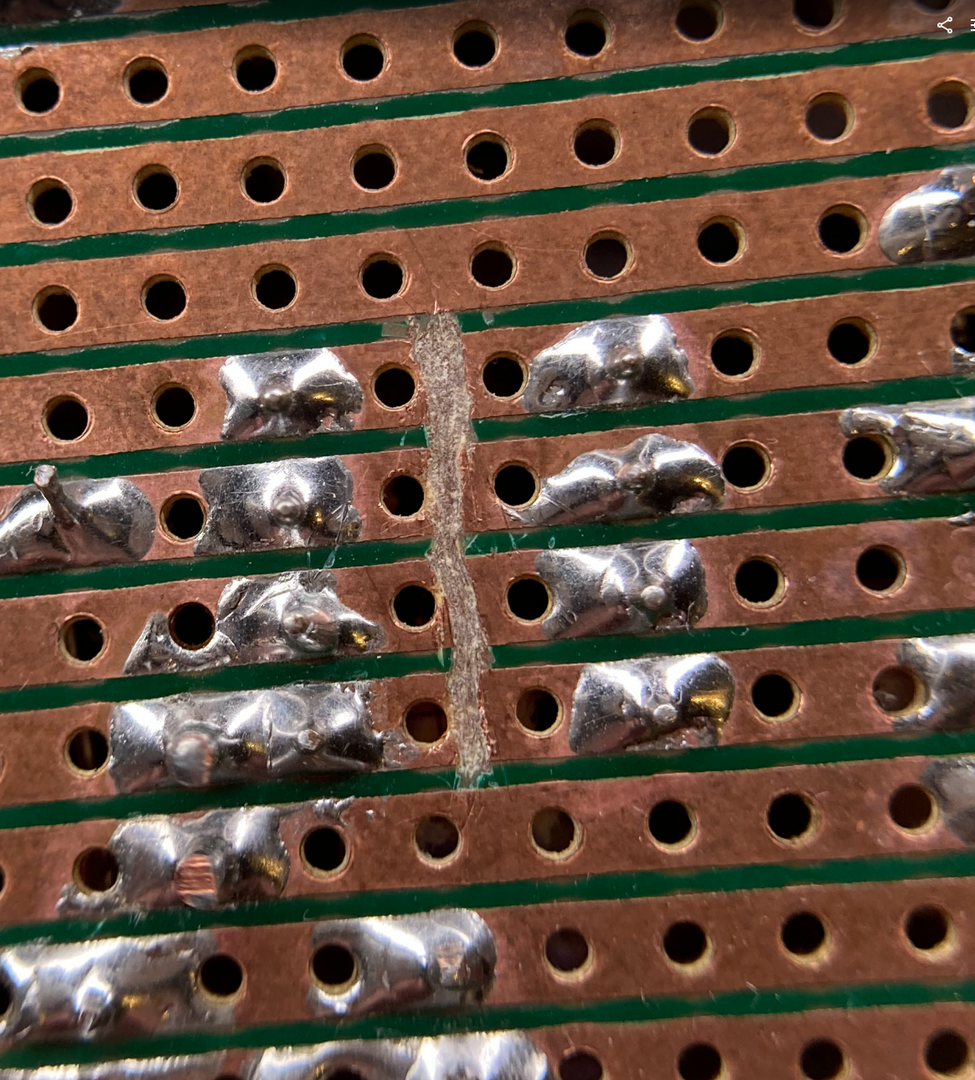
2) A/C (Pin 6)
It's really there, 16.9 with the capsule connected.
I don't have an oscilloscope, unfortunately.I haven't got such a device yet, and I don't know how to use it either.
I remembered that I also have a USB tester like this.
There is also a measurement of the circuit consumption, 0.33A together with THAT.
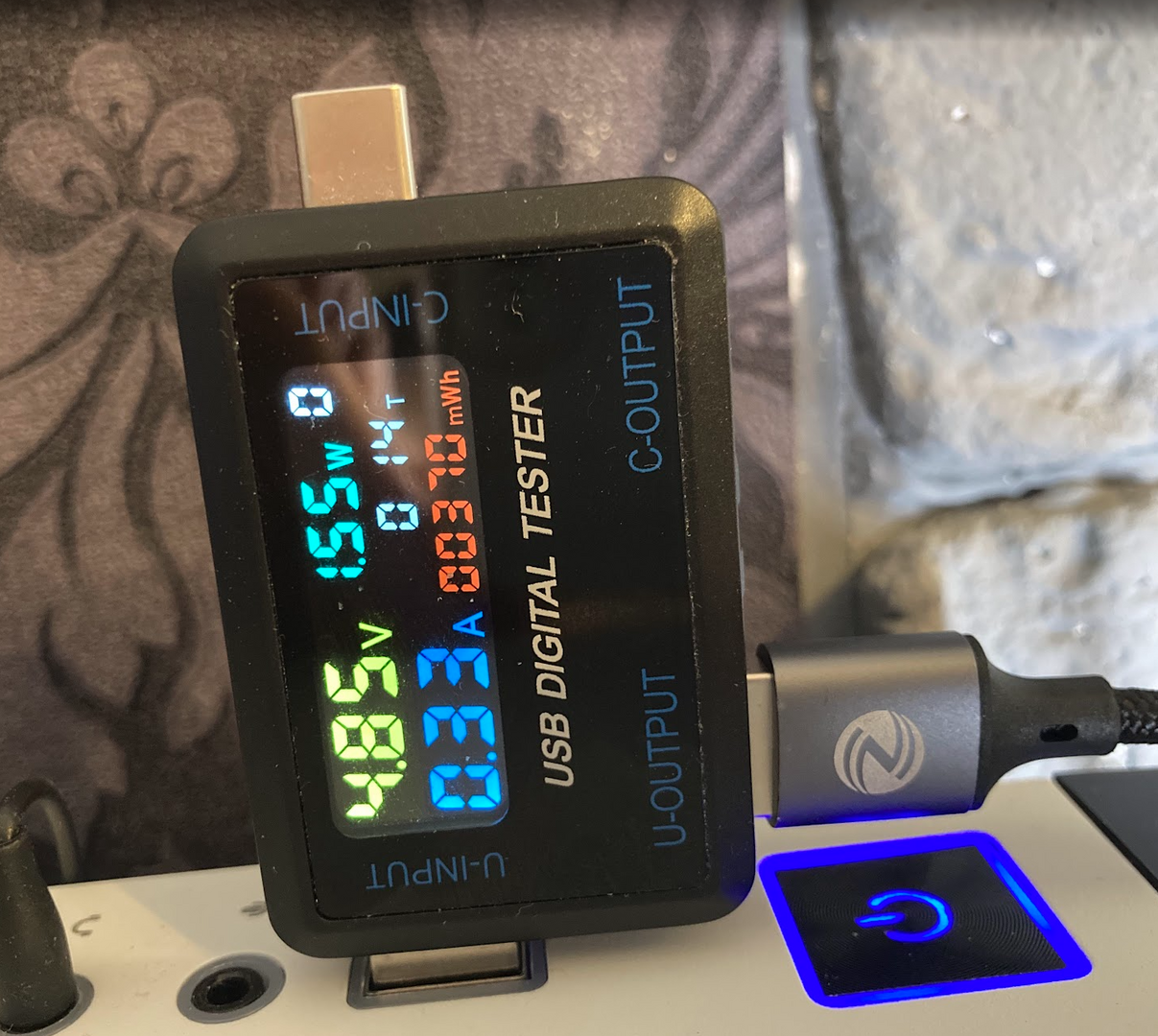
I reread all 33 pages and no one had a similar situation except one guy from Ukraine.
I just live in Ukraine too and bought all components on Ali, the situation is similar, it's warming up and no signs of life of the circuit.
But I thought that if the chip is defective it should at least give some noise and interference, but here it is silence practically
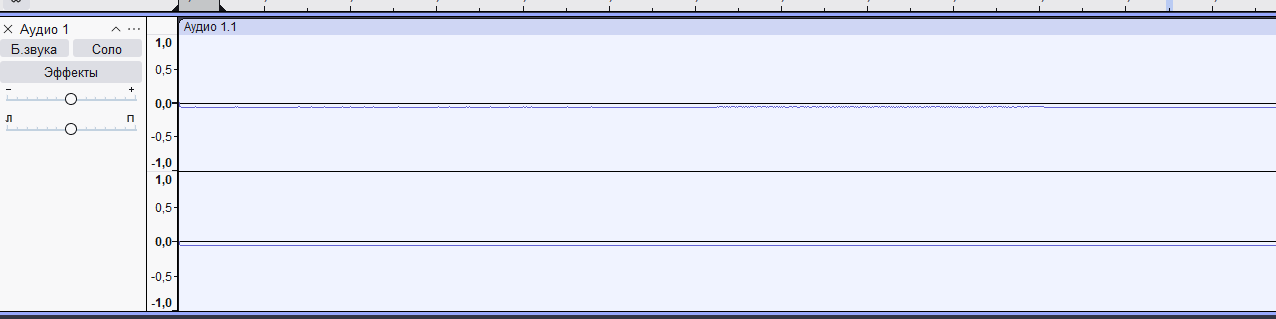
If you touch the Audio interface circuitry, there is touch noise, but nowhere else.
Well, except as I wrote above slightly noticeable from touching the capsule body, on the photo this peak is noticeable
P.S: Looking forward to the V2 from Matt and you, when I read about it on the forum, I was even kinda upset that I built this circuit ahahahahahaha
Posted : 03/05/2025 12:41 pm
330mA draw is expected from the USB due to the inverter (NMA0515) which provides the total 30V required to power the circuit. I'm stumped at the moment as to why the THAT is running so hard as to pull the supplies down.
I have a simplified version of Matt's original here and (with the inputs shorted to each other, not ground) the THAT's output sits at a few mV DC which is expected. This is directly at the pin - not via the blocking capacitor.
I'll have to run some more test (I managed to snap the pin of one of my last 1512s which was clumsy) and see if I can replicate what you're getting.
The V2 boards are available from JLCPCB now, everything from a dual output, noise reduced power supply all the way through to an almost complete all-in-one. Way more than Matt could run a video on, I expect he'll use the modular one as it's more compatible with the original design (as you've made). There are THAT versions using the original chip and the new design that is mostly discrete.
There are a couple of minor hiccups on some of the silkscreens I need to correct. One had the +ve and -ve power inputs reverse which was really dumb of me)!
Take everything I say with a pinch of salt, I might be wrong and it's a very *expensive* way to learn!
Posted : 03/05/2025 7:34 pm
PolarYetti reacted
@marcdraco Then I will wait to hear back from you when you have a chance to figure out what the matter is, for I too am puzzled.
Will the new V2 version be available to buy for printing ? To buy it
Posted : 03/05/2025 8:03 pm
@polaryetti You can find various parts (some complete, some modular and some purely experimental) at GitHub/marcdraco
Some of these might never make it out of prototyping stage - it's hard to know how well they work (if at all, and I've made a few duds!) until they are tested in a working system, but you can get a peek at what's to come.
A lot depends on how much work you want to do, some of the designs are essentially "ARTF" (almost ready to fly) if you order them made up at JLCPCB. I haven't had time to test most of the "through hole" versions except Katie which, by design, doesn't feature a power unit.
The Liza power supply is a separate module that produces two 15/-15 outputs with a fully isolated ground. You'll see everything you need there, I have tested "Jane" which is a dual version (the capsule adaptor board can be snapped off and used separately). A through-hole, THAT1512 variation is also there (Bobbi) but that isn't fully tested as yet.
The reason there are so many experimental and odd looking variations is to cover different use cases - including converting the infamous BM800 mic body into something of much better quality.
When Matt's had a chance to play around with some of them (which could be a few months) some of them will fall by the wayside and we'll settle on the best way forward. The fully integrated boards are the most cost effective (cheaper still for those with SMD equipment) running at under £10 per board complete.
Take everything I say with a pinch of salt, I might be wrong and it's a very *expensive* way to learn!
Posted : 03/05/2025 8:27 pm
PolarYetti reacted
@marcdraco
I got it,, watched them on your github earlier.
Then I'll wait for the final version, and in the meantime I need to at least deal with mine, it's not for nothing I started this case, I already need to finish it).
It would be a shame to put in the time and not have it be for nothing.
Posted : 03/05/2025 8:42 pm
marcdraco reacted
Yeah, completely agree. The new boards (some of them anyway) are compatible with the microphone and capsule arrangement that Matt designed - the thing that really kicked me in to action, it's so beautiful and unique - with a steampunk look that I love.
Matt's dual polarity (30v) design also makes the microphone far more sensitive than the typical 2 - 10V bias we usually use in a JFET amp - you can see that in the schematics of Jamie for example. It's unusual and does add some distortion but it's minimal and overcome by that extra gain.
I'm leaning toward this method but there's a purely 5V one in the works which is simpler still ... IF I got my maths right which is a big if. 😉
As I've noted earlier in this thread, simulation (LTSpice, TINA TI, etc.) can only get you so far. I've had oscillators that work perfectly in a sim refuse to behave on a PCB because of component tolerance, etc. hence some of the new ones use a completely different, theoretically quite noisy, VHF oscillator. It'll be interesting to see if any of these work.
The digitiser board is currently having a couple of improvements to (the regulator was getting a wee bit hot). However, it's got a USB codec, ADC and DAC on board so we can even remove the Audiograbber altogether.
I'm also leaning toward a dual capsule version which can give us cardioid, figure 8 and omni patterns at the flick of a switch. It's a very simple modification although Matt's capsule carrier design would need a complete re-work.
The original ([cough] when it works [cough]) is outstanding and it's only right that I make the V2 better for everyone - and we've already done some "firsts" in the creator space, I could do more but I'm working on a limited budget so it's a bit of a slow process. I may even re-do the famous Alice which is based on a OPA2134 but make it smaller still... There's a form factor I haven't tried yet that suits the BM800 perfectly - with a dual capsule head at that. The gotcha there is it means quite a bit of metalwork to give the assembly room to pass through into the cage.
Take everything I say with a pinch of salt, I might be wrong and it's a very *expensive* way to learn!
Posted : 03/05/2025 9:07 pm
PolarYetti reacted
A question like this.
I took off the chip, and checked pin 4 and 5 in the dialer mode, and the resistance is 268o hm, so should be ?
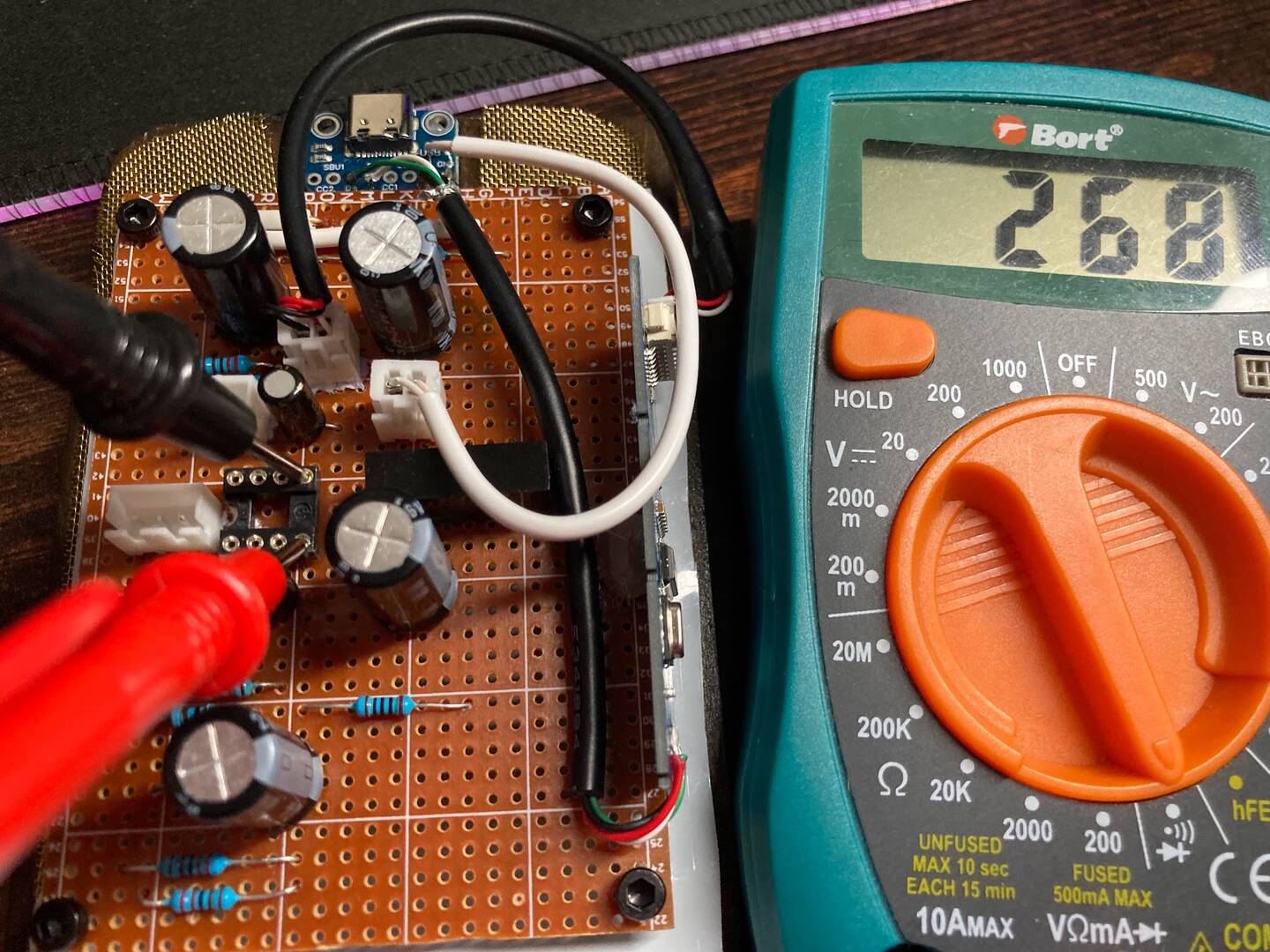
Between 2 and 6 is 5.8k ohms.
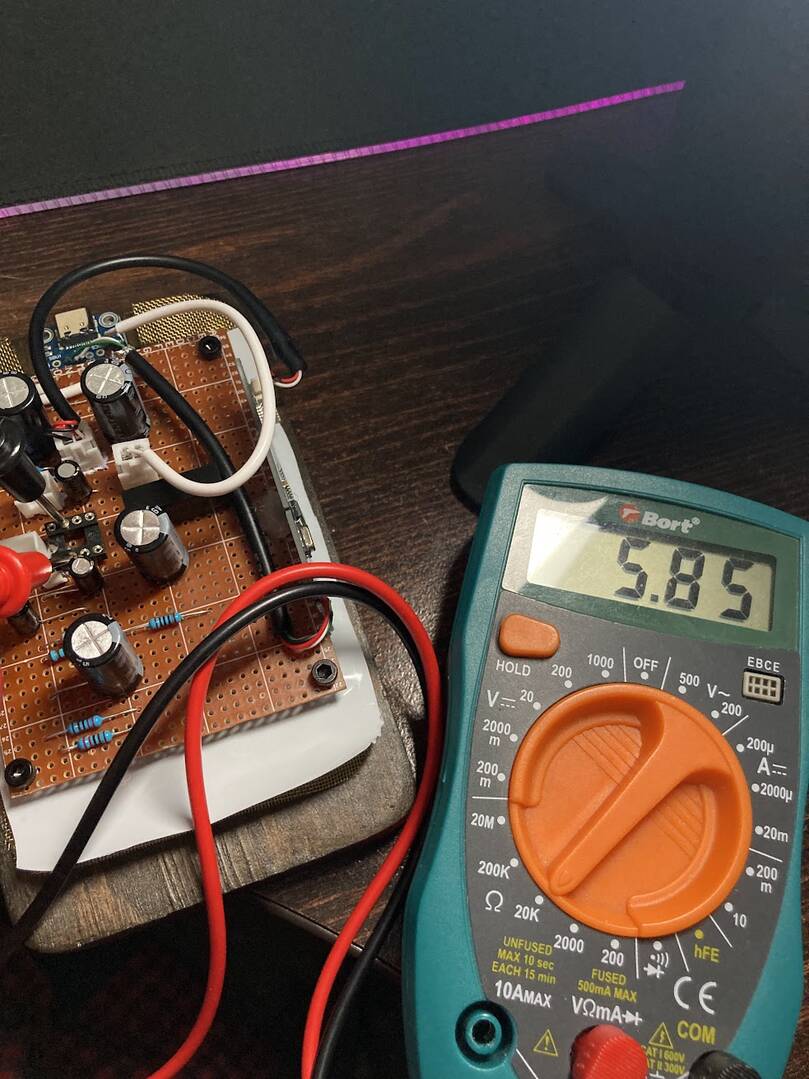
Posted : 05/05/2025 8:45 pm
In nhe top pic, you've got the diode range selected, that will give you a voltage drop (diode drop) so the figure there is probably in mV, not resistance in ohms.
Way to check this (mostly) is with the chip in out of circuit and test for voltages referenced to pin 5 (ground) with the black lead and see what pops up on the other pins.
You should have (around) 15 -> 20 volts on Pin 7, and negative 15 -> 20 volts on pin 4 to establish the NMA0515 is doing it's job. Although it's rated to 15 and -15, it's not regulated so it tends to float a little higher when there's no load (like and amplifier chip).
Pins 1, 6 and 8 shouldn't have have any signal at all (not even a few mV). Remember that if your gain switch is in position, you'll be able to measure resistance of the chain at between 1 and 8 (and infinite if it's unplugged).
Don't worry about the inputs at this stage (2 and 3) as they have capacitors on them blocking the 15 and -15v from the JFET supply.
Also try checking for resistance between each pin in the socket (1 and 2, 2 and 3) and so on - mostly for shorts just to be sure.
Take everything I say with a pinch of salt, I might be wrong and it's a very *expensive* way to learn!
Posted : 06/05/2025 11:36 am

Checked the voltage on the pins without the chip
1 = 0V
2 = 0V
3 = 0V
4 = -14.55V
5 --- that's the reference.
6 = 0.0V But at first it was 0.1 or a little more.
7 = +14.55V
8 = 0VWith the chip
1 = -2.93V
2 = 0V
3 = 0V
4 = -8.28V
5 --- that's the reference.
6 = 0.0V
7 = +10.55V
8 = 0VBut that's without the capsule connected
I would say that IC is toast
Posted : 07/05/2025 3:17 am
marcdraco reacted
Admittedly that doesn’t look good.
Take everything I say with a pinch of salt, I might be wrong and it's a very *expensive* way to learn!
Posted : 07/05/2025 3:49 am
@marcdraco
On your lisa supply, I have done similar to reduce ripple and found having a resistor across C5 and C6 helps ripple and regulation. If you have time, try it.
I also like to sprinkle 0.1uf caps in Vin/Vouts of the regulator and main outputs (it makes me feel good, haha)!
If your not battery powered, try more output preload (say from the 4mA the leds are burning) to 10~15mA total, it reduced ripple a bit more.
Posted : 07/05/2025 4:15 am
marcdraco reacted
I ordered a new THAT1512 and NMA0515SC, and assembled a new circuit, I will test on the new sample
Posted : 07/05/2025 5:11 am
marcdraco reacted
@oz Hi Oz, I should send you my pre-JLC schematics - you'd probably stop me from standing on rakes like a did on the last batch missing a couple of digital grounds off... It's obvious when I look at now it but you know how it is when you've got several hundred balls in the air. 🙂 Good to "see" you again BTW.
I agree that you can never have enough 100nF caps floating around the board. I did originally put some 1uF tantalums in there (for the low ESR) to support the 10uF but there wasn't a whole lot of difference as MLCCs are pretty low anyway.
Putting 100nFs near to ICs (for people wondering) is important because the impedance of the wires comes into effect as frequencies increase and inductance (as tiny as it is) starts to kick in too, so they need to be close to minimise that effect. Larger capacitors (bulk storage) above 1uF can be much further away since the effect gets smaller the more current the bulk can dump. This is especially important for very high-speed digital logic as we can suffer from ground bounce where the switching currents cause short, but very large current spikes that cause the ground reference point to raise or lower in respect to everything and that bleeds onto the outputs.
I agree that some form of bleeder does tend to lower ripple a bit but we're limited to 1W total output on the NMA0515 - (another rake I stepped on blindly early on) so if we dropped that much load on the it, the output will buckle.
Mind you those modern LEDs are blinding when driven at "normal" currents well below their pulse max. I can remember early red LEDs glowing gently in the dark when presented with 20mA which seems like an awful lot now. The greens ones are particularly bright because our eyes are more sensitive in the green part of the spectra. Red was all we had then (or orange if they put the right epoxy on there). Green - then blue/white and lasers didn't appear until I'd transitioned from design to writing professionally. It's incredible how far technology has advanced over the time. PNP was all the rage (easier to make maybe?) and power MOSFETs were still largely a fever dream, with most amps of the day relying on 2n3055s which are laughably inefficient compared to modern systems. My first computer had a massive 256 bytes of memory (unless you include the calculator which, IIRC had 32 steps and only two branch instructions (goto and GIN - go if negative). Genuine nostalgia aside, I don't miss those days
I think a better improvement would be to swap out the single transistors for pre-made Darlington pairs (integrated ones often have the speed up resistor on the die). It would cost us another Vce drop (short of using a Szlaki pair) but it would improve the ripple rejection quite a bit too.
@Oz please do (and this isn't sarcasm) feel free to "fork" the Liza or any of the other designs, if you can improve them, I'll put your changes on the "official" Git repos. That's why Matt and I have decided to make everything Open Source Hardware, the community will get an excellent video that we've come to expect and the maker community will get a mic that put many commercial offerings to shame.
Now the THAT Corp./Douglas Self versions are working as they should, I'm developing a gm booster to run around 4V so we can dump those, plus a few other tricks that aren't possible with the current "Audiograbber" digitiser. It requires a 5V peak-to-peak swing at the input for max output. 1V2 is perfectly achievable with reasonably priced op amps, so a discrete 3-amp INA will suffice with the right A2D (which I have found JLC does stock). Better CMMR with precision resistors but I doubt that will be necessary for a balanced line for a condenser.
The gm booster (I've already used one on Varee with excellent results) improves the JFETs linearity quite a bit and although I can't hear the difference, that's probably just my hearing. I did try an op-amp in (in place of the PNP part) but the input noise swamped the signal to the point it was unusable. I used a TL072 fully expecting it to be noisy but to get it down to sub-signal levels required the use of something quite exotic and well outside of the budget - particularly when a single, low-noise jellybean PNP like a 2N3906 does the job just as well.
I'm quite ancient now (when I attended school we had just transitioned from stone tablets to chalk and dark slate). At least it was easy to erase a mistake with a bit of spit on the end of a pinkie. 😉
I've been playing a lot of catch up with modern parts. Joking aside, when I was first learning the hobby, germanium transistors were all the rage but thermionic valves were still powering the majority of equipment - most of which ran from the mains. Hence I got a *lot* of shocks trying to learn by poking around radios and televisions with a WW2-era Avo - (and fair amount of exposure to lead compounds which probably explains a lot).
Being able to read the magazines would have helped too. I have a condition related to dyslexia and also dyscalculia which didn't show up until I was in my 20s and by that time, I was learning to write professionally: imagine that for irony! Overcoming that was a real hill and it still slows me down even now. You're probably too young to remember, but can remember when the 100MHz barrier was broken (for consumer CPUs) and most of us thought that would never be possible. Gordon Moore was right all along. 🙂
Totally off topic, but did you see that analogue CPUs are now in development - using light? Probably going to be limited in what sort of calculations they can do but the difference will be a "quantum" leap in speed an efficiency. (If you'll pardon the quantum physics quip, it just seems apropos since we're talking about light.)
For folks who aren't familiar with the early days, op amps, more correctly called operational amplifiers got that name because they were found in early analogue computers that could do complex calculations (including calculus functions such as integration and differentiation) at the speed that the fields run along the wires - about 2/3 light speed. Now that's FAST, esp. if the alternative is a huge bank of valves and a machine that fills an entire floor of an office block. My pocket calculator can do those (and a lot more besides) but that's only due to advancements in VLSI, that an the tiny batteries last months... Now if I can only live long enough to get an RTX chip based on light, imagine the graphics we could get! 🙂 If they figure out how to make AI run on those chips, it'll potentially save a lot of energy too.
Take everything I say with a pinch of salt, I might be wrong and it's a very *expensive* way to learn!
Posted : 07/05/2025 12:49 pm

Can anyone help me with this, there are two versions of the 2sk209, the 2sk209-y and 2sk209-gr, which one should i use for the v2?
Posted : 09/05/2025 12:16 pm
I've used the GR which is the more common one at JLC. There's a BL version to which is capable of higher current. In fact, I'm running a 209BL in simulation but with a very low current - in the order of a few tens of micro amperes. The 2N4416 is more suited to the 30V voltage on the original, but developments seem to be heading toward a 5V version which I'll be testing soon.
The most useful part about the different letters is when you need some (simple) constant current source but you don't care too much about what the current is and board space is limited. By connecting the source to the gate terminal, the FET will deliver a fairly constant current over a range of applied voltages although a bipolar device (or something more exotic like an operational amplifier might be used where precision matters).
Take everything I say with a pinch of salt, I might be wrong and it's a very *expensive* way to learn!
Posted : 09/05/2025 12:32 pm
@marcdraco Thanks you! so can i use the Minima board with the 2sk209-gr and attach to the jli-2555 and use the output to connect to back of my pc mic input(temporary)? and that same can be used with the upcoming v2?
Posted : 09/05/2025 1:00 pm