
Notifications
Clear all

Hello, I can't for the love of god figure out whats wrong with the board, I have changed a few stuff from the tutorial for example:
- I'm not using a potenciometer (just a 1k resistor)
- Im also not using a usb c board instead i directly soldered the the power from the board
The board normally connects to my pc and gets recognized but i dont get any sound.
Some other problems: the black box and the THAT chip get pretty warm and also when i measured resistances i got bad readings on:
- Pin 6 (THAT chip) to the white cable on the green board 175k omhs instead of 0 apparently
- Pin 4 and 5 (THAT) have a resistance of only 500 ohms should apparently be around 100k

So does anyone know what could be wrong? I also noticed that the black capacitors are oriented correctly in the video tutorial but not in the schematics

I have marked - and + for the green capacitors red is negative and blue positive btw
Posted : 14/03/2026 7:23 pm

Circuit impedance (measured in circuit) can be very deceiving unless you designed the whole thing yourself and know what to expect. As the THAT is a black box, we don't.
So - it sounds like you hit the H/F noise problem - the THAT is just blasting supersonic noise and there's so much of that there's no power to amplify the real signal.
If you ponder these pages you'll find you're not alone in this, the base design was plagued (and why I spent years, literally, developing one that was fire and forget). I also did a PCB which some people found useful however, let's go with what you got.
A few pages back there's a chap with similar issues so rather than repeat all that I want you to do all the voltage tests there (with black to GND/0V) and red to the other point with an without the THAT in place. That helps me figure out what might be the issue.
Take everything I say with a pinch of salt, I might be wrong and it's a very *expensive* way to learn!
Posted : 15/03/2026 12:46 pm

@marcdraco thanks. Just to be on the safe side with my understanding: I'll need to solder the Js by myself later, and test with different R409s (or try with a pot.) to adjust the gain, am I right?
EDIT: This is the final quote, isnt it too expensive?

i dont want to say these very well designed amplifiers are cheap, but i was expecting a price close to the original entire project (30-40$). If not, in your experience with users in this forum, is it worth it to pay the extra cost in the PCB relative to assembling original electronics? Does the original assembly usually come to a bad result?
This post was modified 7 months ago 2 times by wecan
Posted : 22/03/2026 6:29 pm
Sorry @wecan I'm not being deliberately rude, just I'm on a dead-lion trying to make improvements to my apartment (before the landlady shows up at the end of the week. So far I'm about 2 weeks behind and the place looks like a building site. Complete with paint on the carpets (and worse) ... Soooo I'm kinda slow 0- by all means kick me a PM if desperate.
The price you have there is for TWO completed boards - that's a bind but it's what we have to deal with. If we can get this sufficiently tested (a few other people chime in with changes) I'm sure we could find a distro and get a much better deal but hey ho.
So for practical purposes you're getting two Michelles for the price of... one (sorta) but that's still a damn drag. The delivery pushes it a bit more too.
The gain you get with a board from JLC is fixed - *by design*.
This allows you to jiggle about with other bits and not have to worry about fooling with the gain. The value there is sufficient to knock the VUs of the charts from a typical "cereal packet" condenser.
This allows a little bit of experimentation with the input resistors for the "left" channel - remember this thing is MONO (but with a stereo front end which is for future expansion).
R409 is where your "6-pack" or your pot would (will/can) go. But don't forget that it will be in parallel with the existing 100R value.
NOW, if you're asking should you do it yourself or have this done in the factory: factory every time. You can make this at home if you have a serious setup including a hotplate or an oven. This is not for the feint of heart (well I wouldn't)!
The factory made ones I've had (over the life of the project) I've never had a single one fail due to an error at JLCs end and that's 100s of boards over the last few years.
If you cost out the V1 vs. this they compare very favourably when we compare a veroboard job to a proper factory produced one. Be sure you have the songbird logo right (it'll look awful if your font is wrong). I need to make a SVG up at some point.
Anything I missed? Just holla!
Take everything I say with a pinch of salt, I might be wrong and it's a very *expensive* way to learn!
Posted : 23/03/2026 6:06 pm

@marcdraco Thank you for your hard work ❤️ 🌺
Tomorror I am going to order pcb and parts. So in 2-3 weeks I should post how it wents.
I have two questions:
1. Is this board good for faint sounds, like fan or whisper, capsule probably plays big role in it, but for sure board also plays a role?
2. Are you planning on any other changes that would further improve a quality, or only polishing?
Posted : 24/03/2026 10:14 pm

Good morning!
@marcdraco, sorry for tagging. I would like to confirm about 2 version of microphone. We have discussed several months ago and wondering about where to start! Thank you for your patience and support!
Posted : 25/03/2026 4:06 am
@marcdraco Thank you for your hard work ❤️ 🌺
Tomorror I am going to order pcb and parts. So in 2-3 weeks I should post how it wents.
I have two questions:
1. Is this board good for faint sounds, like fan or whisper, capsule probably plays big role in it, but for sure board also plays a role?
2. Are you planning on any other changes that would further improve a quality, or only polishing?
1. Exquisite - it depends more on your microphone capsule's self-noise (which is caused mostly by air molecules hitting the diaphragm).
2. Anything beyond this point is basically polish. The next "jump" is the sort of thing I can't do on my own, I simply don't have the resources. I've done a P48 compatible power supply but that's not quite ready I'm backed up. However, there's nothing saying someone else can't take the digital (I2S) outputs and hook them to anything from a headphone adaptor to a mixer. There's space on the board for a full sterero setup but it's only designed for Mono (particularly over USB).
Take everything I say with a pinch of salt, I might be wrong and it's a very *expensive* way to learn!
Posted : 25/03/2026 12:12 pm
Hi there, no worries, better to tag me if it's my design(s).
There are some design files further up the thread that can get the final (beta) version. Anything else would be polish and fixing any gremlins that crept in afterwards.
Ideally get a few of these out there. What's crucial is the impedance matching. If you don't get an impedance matched board to the USB spec (it's available from JLC at no extra cost) it likely won't work.
Beyond that and needing some sort of mic head (I use mine with a cheap(ish) capsule because I needed a particularly flat response. The amp itself is steady as a rock (within reason and at a fraction of the usual price) of stuff that would cost far more.
But it's mostly plug and play - you just plug your electret in at the input and audio comes out of the USB-C connector at the other end. Want to listen in? The I2S is available - including the 12MHz audio sync so you're golden there too.
Take everything I say with a pinch of salt, I might be wrong and it's a very *expensive* way to learn!
Posted : 25/03/2026 12:20 pm

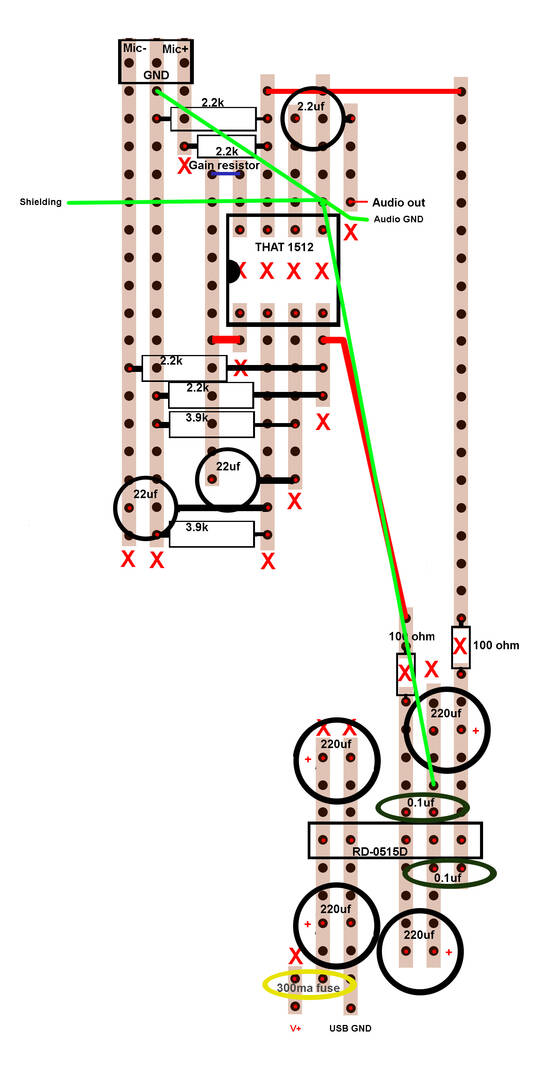
So I accidentally fried mine messing with it. I had to get a new DC-DC convertor. I made a few changes. The 220uf caps are 'cus I happened to have a bag of them and I wanted to save space. Also...the datasheet for the DC-DC convertor says max output capacitance is 330uf (which is more than the 10uf of the original model. Which might be why it fried itself having to charge those caps every time I plugged it in.) I also added those .1uf caps. Again - no math, it's just I had a bag full of them. I moved all the smoothing caps as close as possible to the DC-DC convertor and moved the 100 ohm resistors right next to them, so the long runs are after the caps and resistors now. And I added a fuse. but Imma change that a bit. I borrowed some real estate on the ground strip, right where I'd ideally want the ground wire from the USB to come in. So I'll borrow a bit of the strip to the left instead. (OR just have the circuit board be one row longer. DUH. It's width-ways where space is at a premium in my enclosure) Other than that, it's the same circuit, just with the dirty laundry kept farther away from the clean.
Oh, and I did away with the USB adapter, because I've fried three of them! Audio is gonna go through a 100 ohm resistor and split through two 1k resistors to a 3.5mm jack socket. Then Imma use a 3.5mm to RCA lead to just plug into an External USB adapter. It was just too cramped in my enclosure and the risk of shorting against the sides was too much. Plus all the fiddly little wires...
So I have power via the USB-C socket, and a line-out via the jack.
I just finished the drawing and it's 2:37am, so there WILL be mistakes. Feel free to point them out. I included a version with all the unused strips removed. I'll try to scooch all the stuff below the THAT upwards a bit. I have room to expand lengthways, so I can get a bit more separation between the power section and the rest that way, too. Probably quite considerably. And I can move the socket that connects to the mic capsule back down where it is on the original, so I can shuffle everything after the 100 ohm resistors upwards by an extra 3 holes. I wanna see how much space I need for the jack socket first. it will probably come in from the bottom left.


This post was modified 7 months ago by Ashleigh
Posted : 26/03/2026 2:46 am
Thanks for your answer! I'm new to this, just checking if I got it right.
I can take the latest board design, order it, then just connect an electret mic capsule — and it's basically ready to go?
Thanks!
Posted : 26/03/2026 3:09 am
Thanks for your answer! I'm new to this, just checking if I got it right.
I can take the latest board design, order it, then just connect an electret mic capsule — and it's basically ready to go?
Thanks!
pretty much, yeah. A typical electret might need some gain (you can set the gain on the board with a resistor or a pot)!
Be aware it’s still beta grade so I’m sat on my hands until a few real people are brave enough to try it.
Performance of the original was a hard act to follow and keep the cost reasonable.
Take everything I say with a pinch of salt, I might be wrong and it's a very *expensive* way to learn!
Posted : 26/03/2026 11:13 am
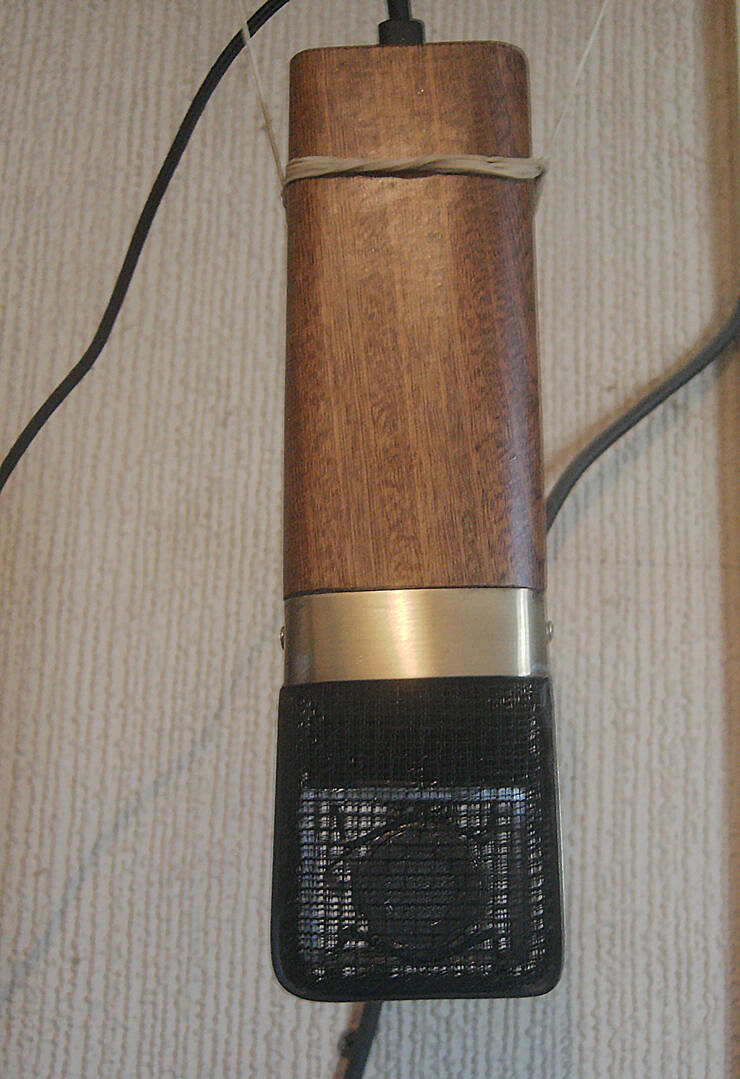
Okay, here's the new layout. The enclosure is 100mm x 50mm. Just a coincidence, 'cus I carved it out of mahogany. So this is the best layout I can come up with using vero board. I was tempted to DIY a PCB. I've done a bunch of toner transfer ones, but the drilling is a pain, and without a drill press, it's a bigger pain, and all the spare components I have are through-hole. I never got into SMD
Anyways, I think it's an improvement over the original layout.
Here's the mic. Eventually, it won't be hanging from my ceiling by elastic bands.
This post was modified 7 months ago by Ashleigh
Posted : 27/03/2026 3:19 pm
Mahogany! Who do you think you are Brian May of Queen who made his own guitar from scrap wood and bits of an old motorcycle.
True dat.
Anyway, yea, that does make more sense in the wider scheme of things.
Take everything I say with a pinch of salt, I might be wrong and it's a very *expensive* way to learn!
Posted : 27/03/2026 3:32 pm
Mahogany! Who do you think you are Brian May of Queen who made his own guitar from scrap wood and bits of an old motorcycle.
True dat.
Anyway, yea, that does make more sense in the wider scheme of things.
Also dat pi... OMFG! That's gorgeous!
This post was modified 7 months ago by marcdraco
Take everything I say with a pinch of salt, I might be wrong and it's a very *expensive* way to learn!
Posted : 27/03/2026 6:09 pm
@marcdraco Hey! After a bit of thinking, could i combine the ideas from Matts "True Wireless Power" video for the wireless transmission, strap a battery and this new amp to achieve a very high end wireless mic?
It would be very nice too, but i dont understand quite how that works, will the audio quality depend on the reciever side or on the transmitter side?
Just an interesting thought i had, what do you think?. Thanks.
EDIT: Also i dont think youre being rude, you have been very helpfull over the last few weeks!.
This post was modified 7 months ago by wecan
Posted : 28/03/2026 2:13 pm
marcdraco reacted
Very gracious of you, I'm having a complete refresh of my man cave. It's time. Making that driving simulator I always promised myself...
The audio of any wireless system depends on the quality (and transmission type) of the radios. However, that said, these days we're working with UHF radio on a short range which is going to be decent quality FM (because there's no reason not to be) OR bluetooth which is either very good (BT4+ audio stream) or very poor (BT communications mode).
My guess is it will be more than adequate. I'll have to look at the datasheet to see how things match up.
Take everything I say with a pinch of salt, I might be wrong and it's a very *expensive* way to learn!
Posted : 29/03/2026 9:15 am

@ashleigh Just popped in to look at some diagrams myself, and oh my goodness that microphone has no right to look so good. AWESOME job! And that's such a good choice of wood, it really works with the black cage.
My worktable is a site of frequent detonations. Please knock so I don't start a Lithium fire when you startle me.
Posted : 29/03/2026 1:59 pm
marcdraco reacted

So i want to build the microphone for a friend, I don't really have any electronic related skills and to be fair I totally lost,Where should I start: with buying the parts or planning it out or getting some soldering lessons, are the resources up to date could anyone help ?
Posted : 29/03/2026 8:53 pm
Welcome: you'll be well supported here but (and this is a big one) you will need some soldering skills to complete the build. The original is the most challenging with various improvements done by myself and others along the way. The V2 you will see mentioned is now in Beta test and is the least difficult one to construct but quite a bit more expensive. I did an alternative PCB to for the V1 (code-named Alpha) but that still requires a lot of soldering.
The capsule end (the really nice looking part) also needs some delicate soldering.
So right now you will need to learn that - it's a very valuable and transferable skill actually. I just soldered some central heating pipe - the alternative was an oversized and ugly setup with compression joints. Similarly doing simple repairs (like fixing a wire to a board) becomes something you can do at home.
I can take you through every step if you want to learn - but soldering is something that does take a little practise from "oh that melts easily" to "that join will hold and it won't just decay over years and cause issues in future".
And from "This thing is like using a ballpoint" to "this is the most delicate quill pen I've ever used. If it were tweezers I could put a hair back into the follicle".
Ok, silly language aside (but leaning into the skill levels from beginner to master) if that sounds like something you want to do, let us know.
Take everything I say with a pinch of salt, I might be wrong and it's a very *expensive* way to learn!
Posted : 30/03/2026 10:27 am
Great to hear that I'm welcome. About learning soldering I could both ask my Dad or a friend (I assume it would be easier to learn with someone beside me, Huge thanks for your offer).
I was thing About 3d - printing some parts for the ease and potential save cost of it compared to to soldering pipes (at least for me).
Does the V2 extra price comes mainly from it being bit easier to assemble or the sound quality being better, is there an estimate how much will it be ?
Do you propose buying parts now and learning while they are in shipment or waiting with ordering them until I'm ready, if i were to buy them now i was looking a bit earlier i and i have found a microphone capsule with seemingly the same name on Aliexpress for half the price do you think it could be in any way a viable option for it or other parts.
As you might've already guessed English is my second language so some patience could be required from your side.
Posted : 30/03/2026 8:40 pm
Don't worry, the translation or your English is quite sufficient.
I would suggest watching some videos on YouTube - an English chap called "Mr Solderfix" has some excellent tutorials: https://www.youtube.com/@mrsolderfix3996
The capsule on Ali is the same one Matt used - be careful to check, it has to be exactly the same for the same performance but I've had a couple from there and mine have been the correct part.
Once you decide if soldering is for you (some people take to it easily, others not) you can decide which version is most suitable. Matt's is the lowest cost to build but the most complex if something goes wrong through to the V2 "Songbird Michelle" mentioned up the thread requires the least soldering but you get two (you can sell the other). Songbird works "out of the box" with a capsule and minimal wiring - it's also significantly better with specs that rival serious commercial gear, and it's expandable later; but it's a case of balancing cost vs. performance.
Take everything I say with a pinch of salt, I might be wrong and it's a very *expensive* way to learn!
Posted : 01/04/2026 9:37 am
Apologies if this is a silly question, but couldn't one buy a decent but cheap microphone--for example I have a JLAB Talk Go microphone, about $40, but it sounds quite good for the price--and replace the capsule in it with a higher quality one? I'm sure there are some capsules that this wouldn't work with, because of built-in JFETS and so on, but could that work? Or are microphone preamp circuits too capsule-specific for this to work? I'm asking 1) because it would be cheaper and 2) because I've done this with lavalier microphones and laptop microphone capsules, and it has worked.
My worktable is a site of frequent detonations. Please knock so I don't start a Lithium fire when you startle me.
Posted : 04/04/2026 11:16 pm
There's more to this than meets the eye - as there are multiple parts to the chain. The main one is the capsule but the distortion is almost entirely due to the actual membrane (type, size even design shape!).
It's the first thing to replace if quality of sound is the issue but consider that even a cheap electret mic these days (back electret which are the vast majority now) is very good indeed. Beyond pure distortion (which is likely inaudible at normal operating pressure) lack of quality (timbre primarily but also detail and frequency response) are to some degree a product of the electronics.
But the excellent news is that none of this matters! 🙂
Almost all electrets these days have internal JFETs and those are almost always the same design -- why reinvent the wheel when you have one that works - mass production here absolutely drives prices through the floor.
TL;DR
Now don't go blowing any Lion batteries up there dude - 😉 - but all you need to do if you're really worried is check for a voltage at the terminals of the capsule (or on the board if that's easier). There's always a 1.2 V --> 10 V, but usually 1.5 to 3 VDC on there to bias the JFET. If the bias voltage is missing it's a FETless capsule but if this is a low cost mic, it won't be.
Take everything I say with a pinch of salt, I might be wrong and it's a very *expensive* way to learn!
Posted : 05/04/2026 10:31 am

Hi! I’ve been reading through the DIY Perks USB-C microphone thread and your project branches with a lot of interest. Thank you for all the work you’ve put into improving and documenting these designs. I found the Alpha schematic PDF, but I couldn’t find the full Alpha project files anywhere. Could you send me the Alpha files if they’re available ?
Also, from your current projects, which one would you recommend building today if I already have the tools for soldering and a decent stock of common resistors, capacitors, diodes, and similar parts?
I’m mainly looking for the best practical option, ideally something still close to the original DIY Perks mic but improved.
Thanks !
Posted : 10/04/2026 3:03 pm
Hi Slisov,
I personally prefer Songbird "Michelle" but she has to be considered beta quality now. (I need to order some more boards when things pick up to see if anything falls off or shows up weird). Best compatibility with Matt's is Alpha (cheaper short term, off the shelf parts). I've never been very happy with the ones I made but at least one active member has made one and was very happy with it.
Take everything I say with a pinch of salt, I might be wrong and it's a very *expensive* way to learn!
Posted : 10/04/2026 4:45 pm
@marcdraco Hey! Have you looked into that wireless idea? I’m going to buy that exact model but I have no idea how to exactly wire it or if there is a better alternative to that wireless mic extracted board? Maybe cheaper or better in some way.
Also, is there a very cheap and small amp like matt used but with better quality than the one he used? (It’s because Michelle is too expensive for the moment, if someone has one to sell I could buy it)
Posted : 13/04/2026 9:56 am
I'll have some run off (slow-boat from China - which I hope will actually be an airplane but things look dicey now) and let you know. Just HMU once a month or so to make sure I have done it. I'm building a full-immersion racing sim right now. Mostly from used parts. Which is fun - since the cat likes to steal parts of it and run away. He's supposed to be a cat, but I think someone inserted a dog brain by mis
take.
Anyway, answer, briefly yes. I think our best solution is a
- SI4463 / SI4432 module pair
- Configure for:
- ~50–100 kHz bandwidth
- FSK
SEEMS to be the way to go (but I've only thrown that at some AI to see WE (you and I) can buy down the local electronics store or on eBay.
Take everything I say with a pinch of salt, I might be wrong and it's a very *expensive* way to learn!
Posted : 13/04/2026 2:03 pm
@marcdraco Maybe I didn't make myself clear enough--I meant, couldn't one get around designing a whole preamp circuit by simply stealing a pre-made preamp board from an existing microphone? And then attaching a higher quality microphone capsule in place of the original to achieve a higher-quality sound than the original mic?
My worktable is a site of frequent detonations. Please knock so I don't start a Lithium fire when you startle me.
Posted : 14/04/2026 11:43 pm
marcdraco reacted
Sorry. (d’uh). Also I made the awful blunder of forgetting to complete the reply to your response - that's on me and I do apologise.
To a degree yes, but the question is one of matching preamps to capsules. GP electrets from the likes of JLI are very good indeed.
That said the main issue (depending on the electronics) is the noise - background hiss. The Michelle is audibly considerably quieter than Alpha or Matt’s original on which it’s based.
UHF mics - the ones that the actual pros use are generally very high fequency - and likely use digital to "cut out the middle man" so to speak. This isn't trival (I know right, there's a shocker).
Depending on where you live there might be a licence-free band that has the bandwidth to carry decent audio. 88 - 108MHz is good but it's used by the commerical broadcasters in the UK and the penatly for interfering with The Archers or PM on radio 4 is serious (OK, I'm having a poke at the BBC but it's OFCOM that does this and they are extremely strict. Even though I could show you how to build an FM transmitter with a decent pre-/de-emphasis and a range of, ohhh, 20-50M, I think to keep this educational I'd refer you to some of the less regulated parts of the web. You can even get some "spy" gear these days that's surprisingly good. So I hear (cough).
The alternative (and this is what I do to stay legal) is to use a small Bluetooth kit. You can get pre-made tranceivers (with a swtich) for about the price of a decent pint of real ale and a parmo. (@diyperks would know what I mean if you don't, bit of a local delicacy - [smacks lips] ). 😉
The issue with Bluetooth is the latency and they can't occasionally cut out too (if they detect some error in the stream, I assume).
Does that help. Again, I really am sorry for the extended delay, I must have been distracted by a starving cat - and he talks with his claws in my furniture.
Take everything I say with a pinch of salt, I might be wrong and it's a very *expensive* way to learn!
Posted : 19/04/2026 8:32 am
Muzammil17 reacted
All good! Well, I suppose if I'm going to do it, I might as well do it properly anyway, because at least that way I get to customize it. And do some real electrical engineering in the process.
My worktable is a site of frequent detonations. Please knock so I don't start a Lithium fire when you startle me.
Posted : 19/04/2026 6:54 pm
marcdraco reacted